

Intro
Leading the Academic Applications team at Quanser, I get the opportunity to explore how simulation, hardware, and rapid prototyping tools can be used to accelerate students’ workflow from concept development to real-world validation. An example application is the AI segment for Formula Students which occurs in Silverston UK. From a competition perspective the AI segment challenges teams to develop autonomous driving solutions using simulation tools, vehicle models, sensor information, and control algorithms. The competition environment give teams a structured way to experiment with key autonomous driving concepts such as perception, localization, path planning, and vehicle control, while still connecting those ideas to complex driving tasks. One of the most valuable parts of the event are the conversations with student teams and seeing how each group tackles the same challenge using different software architectures, controller designs, and testing strategies. My objective in this blog is to present a retrospective view of the FS-AI competition along with providing guidance on how Quanser users can utilize our solutions to prepare for a time crunched competition like the one happening in Silverstone UK.
Prep
As with any good competition, lead-up and preparation is very important. In March of 2026 the Institution of Mechanical Engineers (IMechE) gave an introductory webinar walking through the technical documentation for the ADS cars used during the race day. Students also get a walkthrough of the HIL simulator provided by ZF, sensor information and quality of life improvements for the vehicle. Understanding the vehicle information was a key part for planning how to communicate and test the communication structure provided by the IMechE vehicle. Technical presentations like these provide students with guidance on the types of sensors they will see as part of the competition. Starting from this date students can start organizing the technical backbone of their driving stack. Students which competed in previous years will also have an indication of the types of competitions their algorithms will have to compete in. These events include:
- Acceleration
- Skid Pad (Figure 8)
- Sprint
- Track Drive
From a technical perspective students will need to define or update the software architecture used for these challenges. Their approach to software design is key to ensuring a competitive entry to this competition. We can call this stage of the competition the “software design and development” phase.
From an outside perspective looking in, some questions come to mind:
- Should there be one unified software stack which can tackle all challenges?
- Which algorithms are important for autonomous driving?
How each team answers these questions (and it’s possible might be more) will set the stage for their performance during their visit to Silverstone. We’ll come back to these questions to see how Quanser’s academic resources can help during this pivotal stage of the competition.
Competition Week
The week of the competition has arrived, and the teams are now at Silverstone. The biggest crunch is about to happen, and decisions taken during prep time will now have a huge impact on the practical performance of the vehicle. We’re now in the “Application verification and validation” stage. To get a deeper understanding of how students tackled the four AI challenges I went to both the hardware events and the student presentations. Let’s take a closer look at how the teams have tackled some of the questions I posed during the prep stage.
When listening to technical presentations and chatting to teams which came to the Quanser booth I noticed a trend:
- ROS Gazebo to prototype their control and perception algorithms
- Built their software solution based on prior work
- Some teams had a smaller scale solution to prototype some of their algorithms
For teams to compete during the hardware section of the FS-AI event they also needed to demonstrate they could safely operate the vehicle during a static test. A judge would walk students through the rules to demonstrate safe operation of the IMechE vehicle. Competition schedule also dictated when the last day for static testing would be and the stages for all 4 dynamic events. A scheduled timeline also puts pressure on student teams to qualify and ensure they can attempt (or score) at each bracket of the competition. To ensure fairness across teams there was a day where teams could test their code (for the dynamic competitions) on one car at a test track. This enabled teams who passed the static testing to confirm all their hardware interfaces were working correctly.
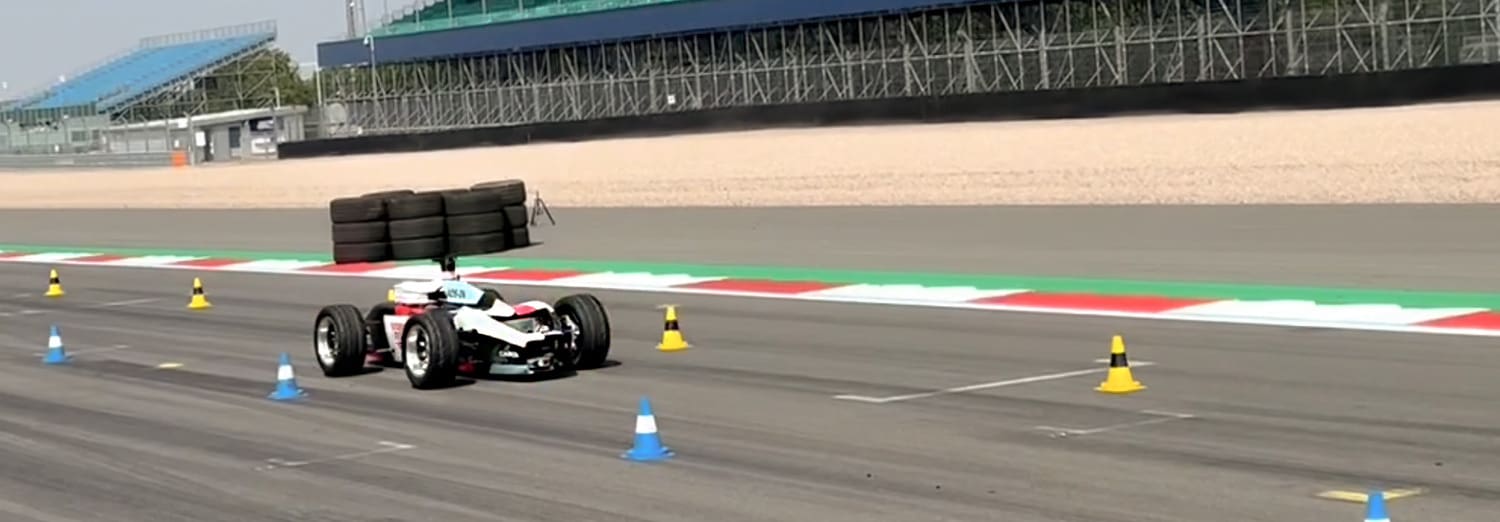
Practically, what was the outcome of the 4 challenges? A series of mixed results. Here is an example of a competing team which was able to perform the acceleration test and ensure their car stopped in the required zone:
Straight Line results during FS-AI week.
For some teams, success looked like their car moving even if their algorithms were not performing ideally, in other cases success meant their car was able to attempt the task without any major issues. This poses a question, how can students teams ensure their solutions can work reliably and test new approaches prior to coming to Silverstone? Here is where Quanser can empower any team.
The Quanser touch
After watching different teams compete and seeing a range of results I began to prototype some of the challenges within QLabs and used our virtual QCar 2. My goal was to have a crack at some of the elements of the competition and to validate some of the assumptions teams can make prior to making it to the actual competition.
Prototyping a straight drive challenge in QLabs
Prototyping the skid pad challenge in QLabs
Prototyping the track drive challenge in QLabs
The results were me, a computer, and a bit of time making sure my code was able to attempt the challenges I saw during the FS-AI competition. The way IMechE has organized the challenges truly tests every element of autonomous racing and causes students to critically think about every approach taken. Taking the time to prototype all the examples and play around with different world scenarios gave me a better insight into how teams can approach the FS-AI competition from a series of different ways. Initially I aimed to use the same approach for every challenge and quickly began to deviate to a unique approach per challenge. It was at this stage, by being a technical developer again, where I began to answer the questions I originally posed.
- Should there be one unified software stack which can tackle all challenges?
I quickly began to make different versions of my python code which were tuned to the challenge at hand while keeping the vehicle interface as a common structure. Retrospectively, I began tunning knobs to my racing algorithm and made different profiles/driving modes which helped me understand the subcomponents required to be successful during each challenge.
- Which algorithms are important for autonomous driving?
All my examples lead back to the same fundamental elements of vision, control, estimation and behaviour planning. The elements that I found useful were going over the skills activities for our QCar 2 content to confirm my knowledge.
Ultimately, I created a hackathon for myself using QLabs and the QCar 2. I only worried about validating my algorithms and my assumptions. Given the work the team has done to make a robust vehicle interface I was also certain that my code would run on our physical device. Bringing this back to the FS-AI competition and to teams which are thinking about getting started and are unsure of where to begin, to you I pose the following questions:
- Are there gaps in my team’s knowledge which can increase the ramp up time for new members?
- How can I understand the concepts that are important for this competition versus upgrades to current implementation?
Competitions such as FS-AI can enrich a student’s academic journey by giving them the opportunity to take everything they learn in class and apply it to a real-world application. This is also where Quanser can help bridge the knowledge, development and validation gap by providing student teams with the curriculum examples necessary to tackle autonomous driving competitions, projects, and research problems. Our contribution to the academic community is to make sure the documentation and activities necessary for competitive results are approachable and hands-on.
By giving students access to flexible prototyping environments, realistic vehicle platforms, and workflows that support tools such as MATLAB, Simulink, Python, ROS, and QUARC, students can focus on developing and validating their algorithms while gaining practical experience with the full autonomous systems development process. If your team is getting ready to participate in autonomous driving competitions, is taking part of FS-AI or looking to upskill their teams I highly recommend you look at our academic content and ask your professors/supervisors to give you access to these tools which can jumpstart your competitive journey.