
Newest academic paradigm, accelerating rapidly
Since the birth of the modern university in the 12th and 13th centuries, academia has experienced only a few true paradigm shifts; each redefining how knowledge is created, shared, and experienced. The printing press (1450s) made learning accessible beyond the monastery, marking the beginning of widespread knowledge sharing (Eisenstein, 1980). The scientific method and laboratory revolution (17th–19th centuries) brought experimentation into education, forming the basis of inquiry-based learning (Shapin, 1996). The Humboldtian model (1809) merged research and teaching, shaping the foundation of the modern research university (Ash, 2006). Later, personal computing (late 20th century) transformed every aspect of academic life, expanding how knowledge could be accessed, created, and communicated (Papert, 1980).
Today, we are witnessing another: the hybrid learning era. Emerging in the 2010s and accelerated after 2020, this model enables seamless movement between simulation and reality, extending learning beyond campus walls while maintaining fidelity. This shift represents what many scholars describe as a defining transformation in higher education, blending digital and physical environments into unified learning experiences (Garrison & Vaughan, 2008; Hodges et al., 2020).
This change is measurable. In Fall 2023, over 53% of U.S. students took at least one online course in fall 2022 (IPEDS/NCES). In CHLOE 9 (2024), U.S. institutions report prioritizing developing online versions of on-campus, pus courses (69%) and degrees (65%). Hybrid and online options are becoming the norm.
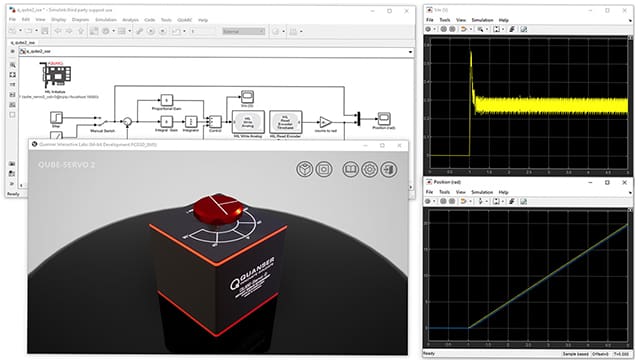
At Quanser, we recognized this transformation early. Our QLabs Digital Twins—high-fidelity virtual replicas of Quanser lab systems, were designed to extend authentic lab experiences. Over the past five years, QLabs has become integral to Quanser’s ecosystem, accelerating universities’ digital transformation and enabling scalable, flexible, and inclusive lab-based education.
This global shift has inspired many universities to rethink how laboratory-based education can evolve in the hybrid era. One such example is Stralsund University of Applied Sciences in Germany, where the DistLab project became a model of how digital and physical experimentation can coexist.
Challenge
Expanding reach of practical learning
“Laboratory courses are an essential part of engineering education, connecting theory with application and cultivating the practical understanding required in real-world engineering,” mentioned by Prof. Jan-Christian Kuhr. Hands-on experience with real devices is critical for building technical competence and professional confidence.
The onset of COVID-19 acted as a trigger that exposed long-standing challenges in laboratory education; limited equipment, large student groups, and short lab sessions that constrained access and learning depth. These bottlenecks existed before the pandemic but became far more visible under restricted on-campus conditions (Webinar by Prof. Jan-Christian Kuhr from Stralsund University of Applied Sciences, Germany, 2025).
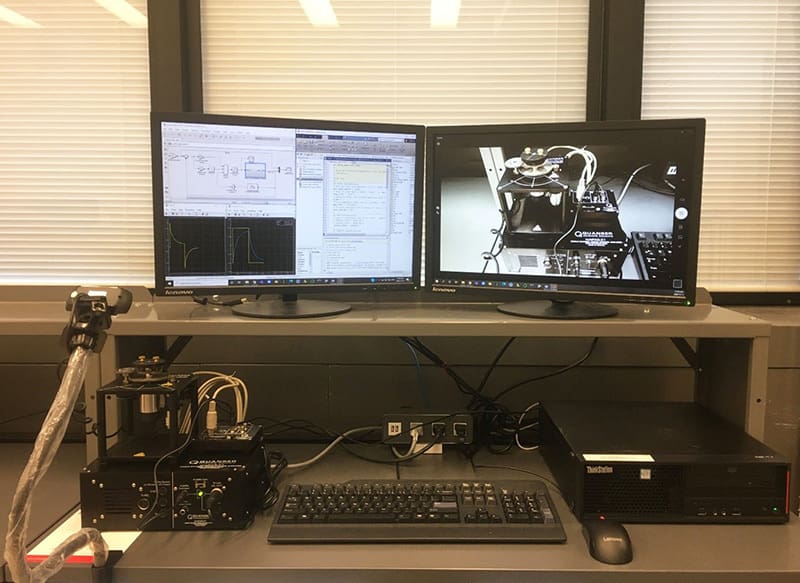
| To address these issues, Stralsund University of Applied Sciences launched DistLab, a cross-faculty modernization initiative designed to maintain the integrity of lab-based education while increasing flexibility and access. DistLab represented a structural shift from traditional, schedule-bound sessions toward a hybrid lab infrastructure capable of supporting both virtual and physical experiments (IEEE, 2022; MATLAB Expo, 2022). |
|

The project required a robust, centralized, and scalable environment that could provide secure access for students and instructors, integrate seamlessly with MATLAB/Simulink, and deliver high-fidelity virtual experiences interoperable with real hardware (IEEE, 2022, ).

Solution
Hardware-centric hybrid lab framework
Building on the need for a robust and authentic hybrid lab environment, Stralsund University of Applied Sciences designed its DistLab framework around the belief that real hardware must remain at the center of engineering education, while virtual twins act as powerful supplements (as mentioned by Prof. Jan-Christian Kuhr). This approach reflects the university’s vision of authentic hybrid learning; where virtual labs expand access and preparation opportunities but never replace the tactile, hands-on experience essential to developing true engineering competence.
A key requirement was interoperability; the ability for students to design and test control systems in simulation and then deploy the same model directly on real hardware with minimal effort. This demanded a platform that could integrate seamlessly with MATLAB/Simulink, the industry-standard environment already used across the university’s programs. Such integration not only simplified implementation but also reinforced industry alignment, ensuring that graduates gain experience in the same tools and workflows used by professional engineers (MATLAB Expo, 2022; IEEE, 2022).

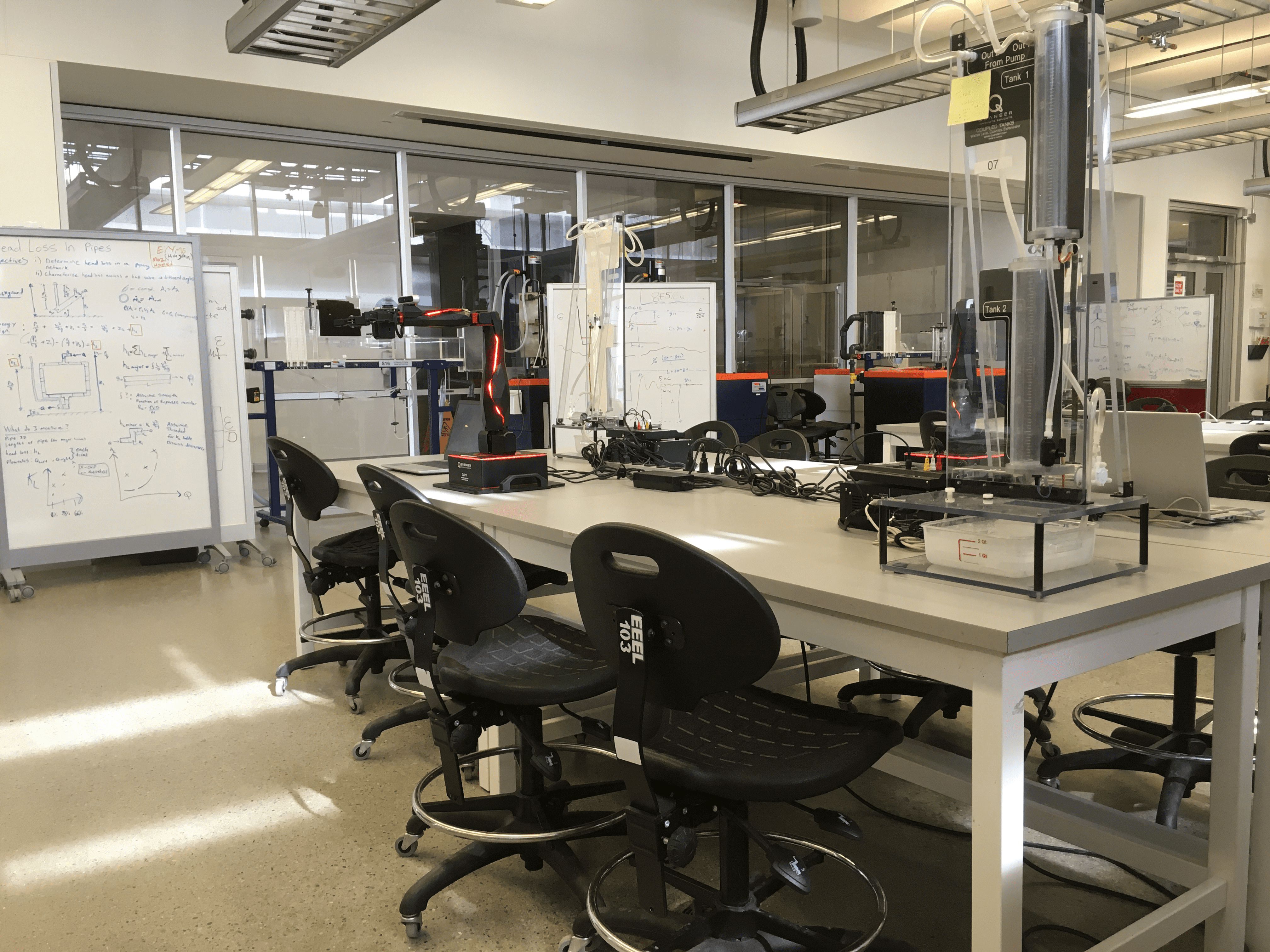
After evaluating multiple options, the university selected the Quanser ecosystem, purpose-built for academia and designed to meet these exact needs (IEEE, 2022). Quanser’s suite of high-fidelity Digital Twins and real laboratory systems—including the Ball and Beam, QUBE-Servo, Coupled Tank, and Aero—offered a unified, high-fidelity platform for both virtual and hands-on experimentation. Importantly, the ecosystem also provides future scalability, with systems like the QArm and QBot ready to support upcoming courses in robotics, autonomy, and intelligent systems; demonstrating the adaptability of the hybrid infrastructure across disciplines (MATLAB Expo, 2022).
In addition to hardware and digital twins, the inclusion of comprehensive academic resources—including courseware, lab guides, and instructor materials—ensured pedagogical continuity between virtual and physical learning modes. This made the DistLab framework not only technically strong but also academically consistent and easy to integrate.

To make this hybrid model scalable and easily accessible, the university implemented a centralized virtual machine (VM) deployment of QLabs and MATLAB/Simulink. Students could log in from any device or operating system without local installation, ensuring a uniform and reliable experience. This infrastructure allowed faculty to support more students per term, reduce technical barriers, and maintain a standardized hybrid lab environment.

Through this integrated approach, the DistLab project established a flexible, high-fidelity, and sustainable model for engineering education—one that sets a new benchmark for hybrid lab delivery: accessible, industry-relevant, and scalable (IEEE, 2022).
Result
When Numbers Speak, the Story Tells Itself
In education, opinions can inspire, but numbers persuade.
| The DistLab initiative at Stralsund University of Applied Sciences produced research-grade evidence showing how a hardware-centered hybrid lab ecosystem measurably improves learning outcomes and operational efficiency. A total of 75 students from four different majors participated in a cross-over study design, where the semester was divided into two periods and students alternated between working with hardware and digital twins (IEEE, 2023). By using the Quanser Ecosystem and Quanser Interactive Labs (QLabs) – deployed through a centralized virtual-machine environment—the university quantified what happens when virtual and physical experimentation truly align. |
|

Quantitative Highlights
|
 |
Together, these metrics illustrate how a cohesive, academically focused ecosystem creates measurable gains for every stakeholder:
- Students: deeper engagement, stronger readiness, and flexible access.
- Instructors: reduced supervision demand and more efficient lab operation.
- Institution: higher process efficiency, capacity to recruit beyond infrastructure limits, improved satisfaction for both students and faculty, and graduates better prepared for industry.
The data explains why Stralsund University continued with QLabs well after the pandemic. Quantitative results showed that the hybrid model not only maintained educational quality but elevated it; turning flexibility, interoperability, and authenticity into sustained academic and operational value.
Conclusion
Scalable lab ecosystem ready to integrate
The DistLab experience demonstrates what is possible when data, design, and pedagogy converge within a single ecosystem. With measurable improvements in student engagement, readiness, and efficiency, hybrid laboratories built on the Quanser Ecosystem and QLabs are redefining how universities deliver engineering education. The result is a model that is scalable, authentic, and future-ready.
If your institution is ready to digitize and modernize its engineering labs, we invite you to connect Quanser Solution Advisor or explore the QLabs Interactive Labs to experience measurable hybrid learning.