

As part of Quanser’s Application Solution team, I spend a lot of time thinking about engineering students: what helps students learn, what experiences we want them to have, and how to make project-based learning both accessible and meaningful. When I think back on my own engineering education, my favorite moments were always hands-on: weekly labs, semester-long builds, and projects where ideas became physical systems.
I was able to build different circuits, from turning on an LED and making a state machine out of logic gates, to building a small robot arm and autonomous car. I was always proud to see the finished result. But those experiences were also riddled with frustration.
There were countless hours spent not doing the fun part. Hours spent “hunting down broken wires”, “troubleshooting incorrectly connected breadboards”, “resolving pin conflicts because two libraries wanted the same GPIO”, “soldering and re-soldering connections”, etc.
I love engineering, but I wish I could have spent less time debugging and more time doing what I thought was fun engineering work: coming up with ideas, designing algorithms, selecting sensors, putting things together and testing my system. This is what we would call defining the design problem and then solving it.
Those problems are exactly what we aim to solve with Quanser’s Mechatronics Design Lab (MDL).
The Challenge in Today’s Mechatronics Classrooms
Walk into most mechatronics classrooms today and you’ll see a familiar pattern: students receive some basic theory, then they’re thrown into project mode where they are expected to learn as they go.
The result? Some students hit walls quickly. Others end up blindly following online tutorials they barely understand just to make something work. The learning experience becomes uneven, frustrating, and often students do not get to experience engineering and mechatronic principles that actually work.
As MDL’s project manager, Crystal described in her blog, when students spend more time troubleshooting hardware than designing systems, core learning outcomes get diluted. The very experiences meant to inspire engineering passion instead become exercises in persistence against technical problems.
But it doesn’t have to be this way.
Building Blocks for Mechatronics
When we developed the Mechatronics Design Lab, I had the opportunity to help shape both the curriculum and the product requirements. Every decision came back to one question: What learning experiences do we want students to have?
The answer shaped everything:
For sensors: Students should read data from any sensor, out of the box. No hunting for obscure libraries. No deciphering conflicting documentation. Just plug in and start exploring what that sensor can tell you about the world.
For actuators: Students should be able to connect most motors and use them immediately. No time wasted figuring out which H-bridge to buy, which board supports their motor, or which connector they need.
For learning progression: Students need scaffolding that builds naturally from fundamentals to complexity. First, during the fundamental labs, students should understand individual sensors and actuators: how they work, when to use them, how to choose them, what their limitations are. Then for the challenges, they can start combining components into systems and learn more coding. Finally, with the projects, they can tackle open-ended design challenges where they engineer complete solutions.
This approach transforms how students engage with mechatronics.
Instead of sinking hours into setup, they get to compare sensor characteristics.
Instead of debugging connections, they experiment with control algorithms.
Instead of following tutorials, they make educated inferences and informed decisions.
When all sensors are read in the same way and all actuators follow consistent interfaces, students can finally compare different options for their projects. They develop design intuition, engineering literacy, system exploration and authentic connections to their projects.
Putting It to the Test
I know what you might be thinking: “This sounds ideal, but does it actually work in practice?”
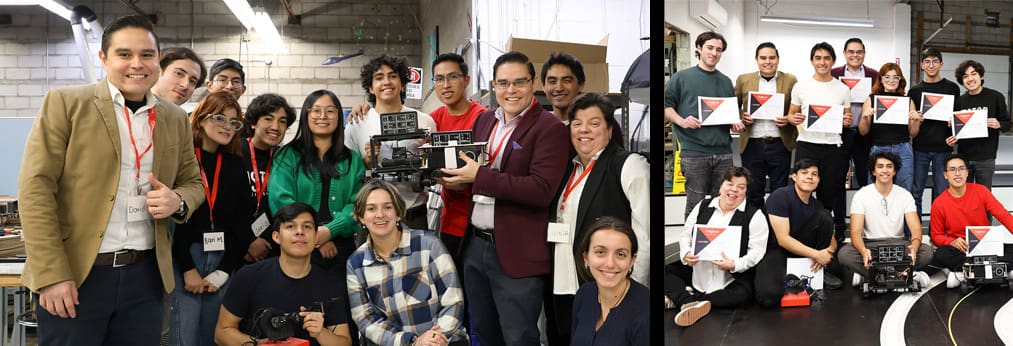
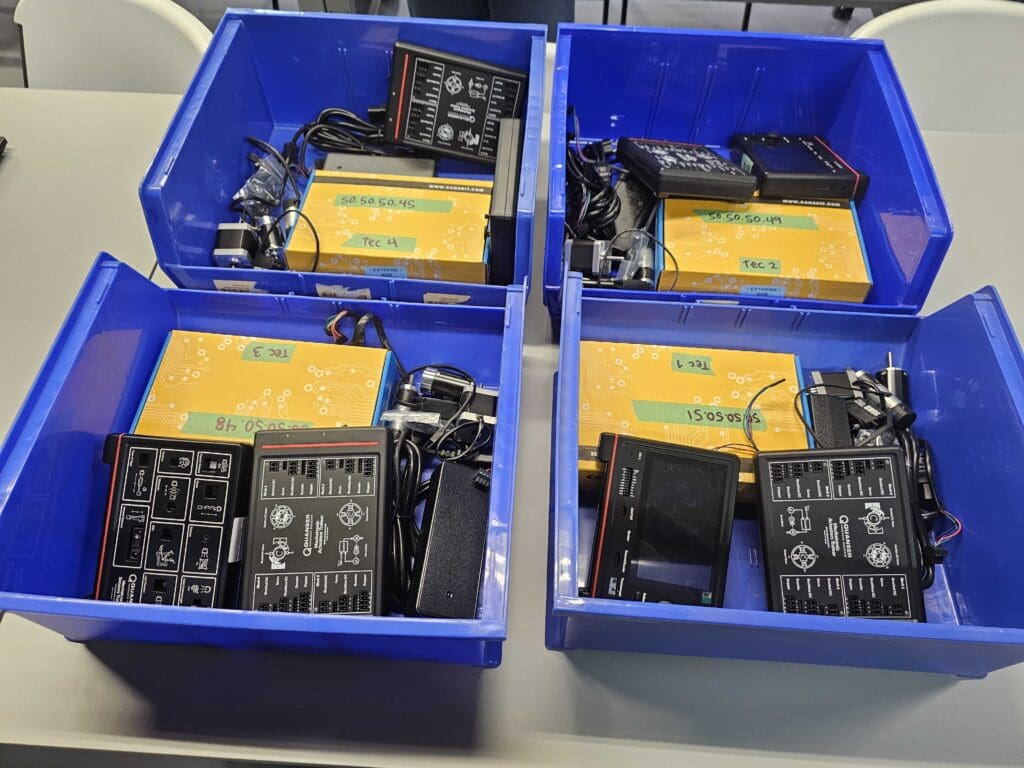
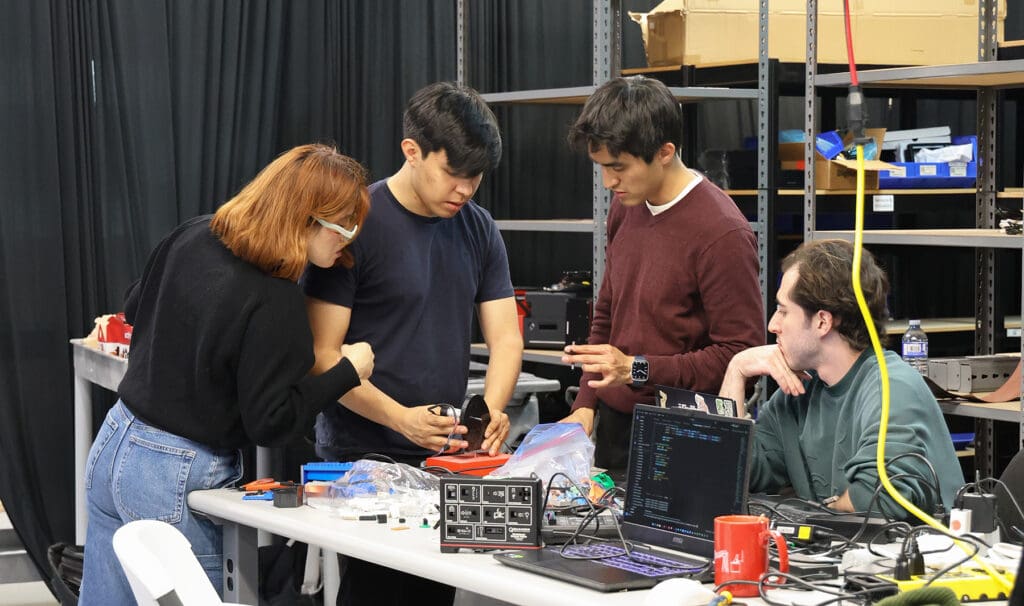
Earlier this month, we put our curriculum to the test. Nine students from Tecnológico de Monterrey visited our office with nothing but ideas and enthusiasm. We gave them access to our Mechatronics Design Lab, Raspberry Pis, 3D printers, and a variety of tools.
In just under two days, they went from initial concepts to working prototypes.
One team built two iterations of a self-balancing robot. Another team created a robotic arm controlled by their own neural network using hand gestures.
Think about that – two days – multiple complete projects. From students who were just seeing the devices for the first time.
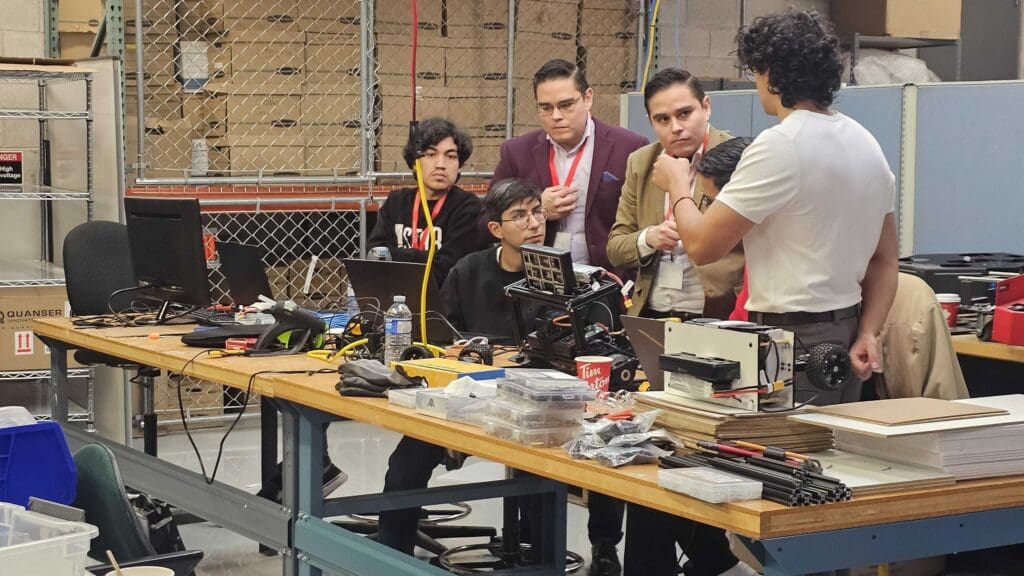
This wasn’t because these students were exceptional (though they certainly were talented). It was because we eliminated the setup overhead that typically consumes 60-70% of project time. Our students spent their time on meaningful engineering tasks: interpreting sensor data, tuning control algorithms, iterating on design concepts, and solving real problems.
This is what hands-on engineering education should look like.
What TEC Faculty Are Saying
And it wasn’t just the students who noticed the difference.
Faculty members Prof. Aline Drivet, Prof. David Alejandro Sotelo Molina, Prof. Carlos Gustavo Sotelo Molina that came with the students from Tecnológico de Monterrey shared how the Mechatronics Design Lab could meaningfully elevate their courses:
“We need to upgrade our sensor labs. Students currently work with older analog sensors that teach the theory, but they would benefit MDL’s modern digital sensors that integrate seamlessly with microcontrollers. I like the variety of sensors also supports AI and machine-learning projects, and the platform is accurate, portable, and programmable in Python.” Prof. Aline Drivet
“MDL helps students understand process dynamics and design control systems, the performance of the implemented controllers can be easily compared. ” Prof. David Alejandro Sotelo Molina
“MDL is useful for project-based courses. You can have many devices working together in one lab, and students expressed the platform is complete, intuitive, and friendly to use.” Prof. Carlos Gustavo Sotelo Molina
They also noted that the Mechatronics Design Lab would be useful across many courses, including Sensors and Instrumentation, Actuators, Introduction to Engineering Design, Mechatronic and Robotic Systems Design, Controls and Instrumentation, Introduction to Control, Introduction to Robotics, Course Design Projects, and Makerspace Training Modules.
Their feedback validated exactly what we designed the MDL to do: remove friction, accelerate learning, and allow students to experience engineering the way it’s meant to be experienced — through purposeful experimentation and rapid iteration.
What This Means for Your Students—and Your Program
The Mechatronics Design Lab isn’t just about making labs easier to manage. It’s about fundamentally changing what students can accomplish in the time you have with them. All while building real confidence in their ability to design complete systems.
This platform supports a wide range of courses, from introductory design to advanced robotics to capstone projects. The same lab that teaches first-year students about sensors becomes the foundation for senior design projects and graduate research.
Empowering the Next Generation of Engineers
Here’s what I’ve learned: when students spend more time designing, testing, and iterating and less time troubleshooting, something powerful happens. They take risks. They explore ambitious ideas. They build functional systems they’re genuinely proud of. Most importantly, they start to see themselves as engineers.
We know hands-on experience matters. The question is: Are those hours spent on experiences that build engineering confidence, or on obstacles that drain it?
Students should be wrestling with engineering trade-offs, not library issues. They should be comparing control algorithms, not debugging breadboard connections. They should be iterating on designs, not on their wiring.
That’s what the Mechatronics Design Lab was built to deliver. It is a platform that empowers students not just to complete assignments, but to engineer solutions they’re proud of.
If you want your students to experience engineering through purposeful experimentation, rapid iteration, and meaningful design, we invite you to explore what the Mechatronics Design Lab can bring to your program. Reach out to our team to explore what’s possible when you give students a project-ready platform that puts engineering first.