
The University of Manchester and Quanser have joined forces in a transformative 10-year strategic partnership that is reshaping how control engineering is taught, applied, and scaled in higher education. Anchored by a shared vision for innovation and academic excellence, this collaboration exemplifies how institutional leadership and cutting-edge technology can come together to shape the future of engineering education.
A Partnership Built on Reputation, Trust, and Vision
The origins of this partnership are as remarkable as its outcomes. During the COVID-19 pandemic, Dr. Alessandro Lanzon, Head of the Control Systems Group at Manchester, reached out to Quanser with a bold challenge: to find a single platform that could support over a dozen control systems courses — from foundational undergraduate labs to advanced master’s-level instruction.
“They evaluated the global market,” recalls Quanser CEO Paul Gilbert, “and ultimately determined that Quanser was head and shoulders above the rest — not just for our technology, but for our academic approach and support model.”
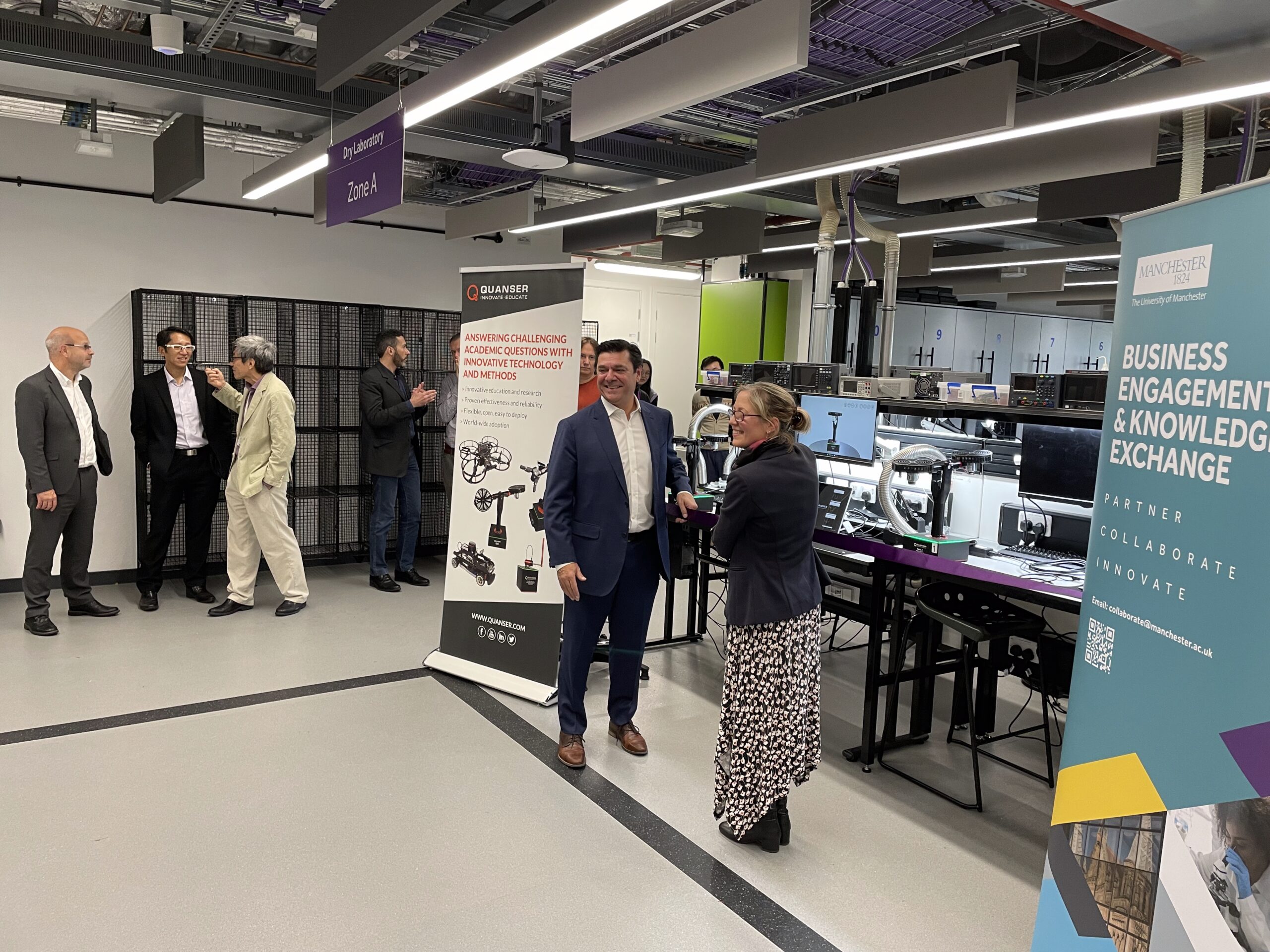
That initial connection quickly evolved into a formal, decade-long collaboration — celebrated in a ribbon-cutting ceremony held at the newly completed Manchester Engineering Campus Development (MECD), the largest engineering campus in the UK. The event was attended by Paul Gilbert, Prof. Alice Larkin (Head of the School of Engineering), and other leaders from both institutions.
An Institution with a Deep Legacy in Control Engineering
Few institutions in the world can claim the depth and pedigree in control systems that Manchester holds. The Control Systems Centre, established in 1966, pioneered one of the first MSc degrees in Control Engineering globally — a program that continues to attract students from around the world to this day.
Control systems education is not confined to one department. It plays a central role across disciplines, including:
-
- Electrical and Electronic Engineering
- Mechanical and Aerospace Engineering
- Chemical Engineering
- Mathematics
- Robotics and Autonomous Systems (a designated Research Beacon at Manchester)
With more than 7,000 engineering students, 350 academics, and a strong research and technical support staff, Manchester’s engineering school is one of the largest and most influential in the UK.
Hands-On Learning and Scalable Innovation
At the core of this collaboration is a shared belief in experiential learning. Manchester is deeply committed to delivering hands-on, real-world education — a philosophy that mirrors Quanser’s own approach.
“They wanted students to have access to the same robust equipment across every level,” says Gilbert. “From introductory principles to complex graduate-level experimentation — all on the same platform.”
The result? A single Quanser system, the Quanser Aero, seamlessly integrated across more than a dozen courses, backed by a fully hybrid model combining hardware with digital twin simulations. Students complete pre-lab assignments using high fidelity Digital Twins developed by Quanser, before transitioning into physical labs — a structure that improves lab efficiency, maximizes faculty time, and enhances student readiness.
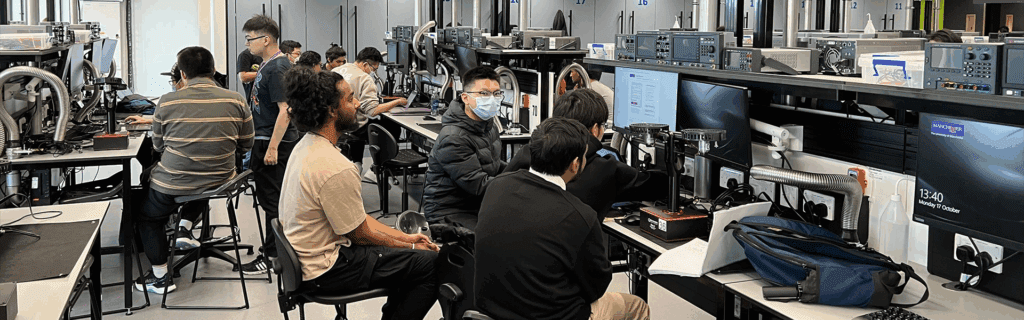
Administratively, it’s also an incredible game-changer: reduced maintenance burden, fewer training bottlenecks, reduced storage requirements and probably most important of all consistent pedagogical quality across years and departments.
Embedded Expertise: A Unique Integration Model
One of the most distinctive elements of this partnership is the presence of an embedded Quanser engineer — a role created specifically to co-develop courseware and support implementation within Manchester’s academic environment.
A Manchester PhD graduate in Control Systems and Robotics, was recruited into this role, becoming a key link between Quanser’s innovation and the university’s academic goals.
This kind of close, boots-on-the-ground collaboration is rare in industry-academic partnerships and it signals Quanser’s commitment to being far more than a vendor. They are an extension of the university’s teaching team.
Building Toward Research and National Impact
While the initial years of the partnership have focused on education, the groundwork has now been laid for research collaboration. As Quanser’s UK presence has grown, the company has invested in new personnel and infrastructure, setting the stage for joint research grants, projects in autonomy, and continued engagement through academic events.
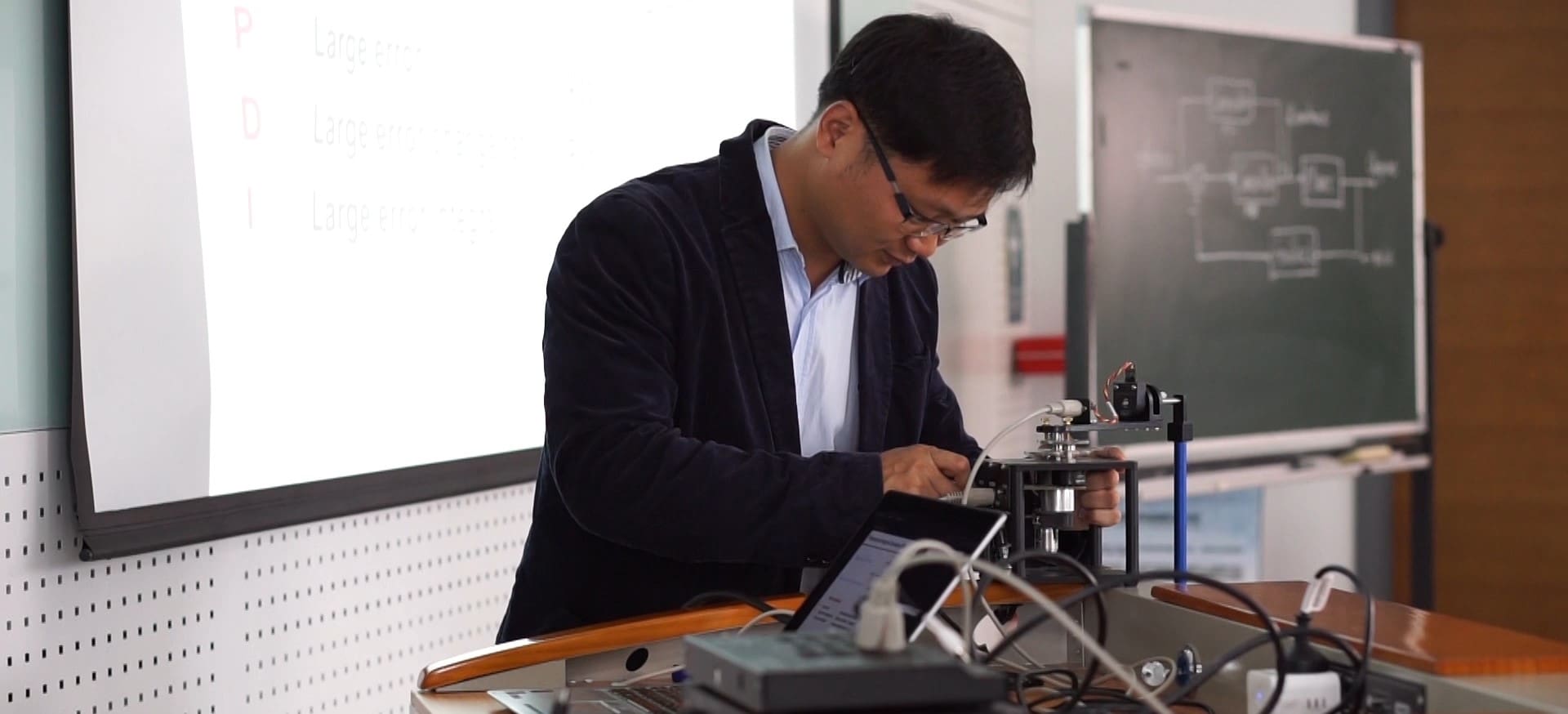
 Paul Karam, Chief Robotics Officer, Quanser at Manchester Rosenbrock Lecture, 2024
Already, the collaboration has elevated both institutions. Quanser now sponsors Manchester’s Rosenbrock Lecture Series, which draws leading researchers and international speakers. The partnership has also opened doors with organizations like MathWorks UK and the Engineering Professors Council (EPC), where Quanser is co-developing a nationwide toolkit for teaching complex intelligent systems.
“This partnership gave us the credibility to walk into national conversations,” Gilbert noted. “Without Manchester, it would have taken much longer to earn that trust.”
A Model That Scales: Lessons for Academic Leaders
The Manchester model is not a one-size-fits-all framework — and that’s precisely the point. Its power lies in collaborative customization.
“We don’t have a fixed structure,” says Gilbert. “We sit down with each university to ask: What are your goals? What matters most to you? Then we co-create a path forward.”
But there are clear themes that other universities can learn from:
-
- Space-efficient infrastructure: One platform, used across all years, minimizes lab space and equipment storage
- Time-efficient teaching: Digital twins reduce in-lab trial-and-error, freeing up instructors to spend more time with students
- Value for money: Scalable, high-quality equipment ensures consistent outcomes without overspending on fragmented tools
- Faculty enablement: Simplified maintenance and curriculum design empower educators to focus on pedagogy and mentoring
This is a strategic partnership — not a transaction. It’s built on cultural alignment, long-term vision, and a commitment to mutual success.
Personal Reflections and Lasting Impact
For Paul Gilbert, this partnership carries both professional and personal significance. It validated years of investment in digital twin technology and accelerated Quanser’s expansion in the UK.
“This partnership let me take a long-held vision and make it real. And when I walk into that lab and see row after row of Quanser systems — it’s deeply rewarding.”
The lab has become a central feature on tours of the MECD. Faculty showcase it with pride. And while the facility doesn’t bear Quanser’s name, its presence is unmistakable.
Ready to Build Your Own Strategic Academic Partnership?
Quanser’s work with the University of Manchester — like its collaborations with Purdue University and others — is reshaping how institutions prepare students for the future of engineering.
Whether you’re launching a new program, scaling hands-on experiences, or reimagining your teaching model, we’re ready to work with you to bring that vision to life.
Let’s build something transformative — together.