

Choosing a research platform is not just a purchase decision. It is a research investment decision. For a researcher, investment shapes student work, publications, lab credibility, and future collaborations. In fast-moving fields like autonomous systems and robotics, where tools change quickly, research priorities shift often, and what looks promising today may not stay relevant for long. One common way to reduce uncertainty is to look at where the research is trending, but a trend is only useful if the work behind it can be trusted.
In 2016, Nature surveyed 1,500 scientists. More than 70 percent said they had failed to reproduce another scientist’s experiment. More than half said they had failed to reproduce their own. The survey pointed to causes such as insufficient replication, poor oversight, and low statistical power.
So, the question becomes more challenging: can we trust the trend?
We believe one deeper challenge sits underneath many reproducibility problems: fragmentation. Every lab uses slightly different hardware, slightly different firmware, and slightly different glue code. Those differences make it harder to compare results, repeat experiments, and build on each other’s work.
This is why Quanser has spent years building what we call a Research Validation Network.
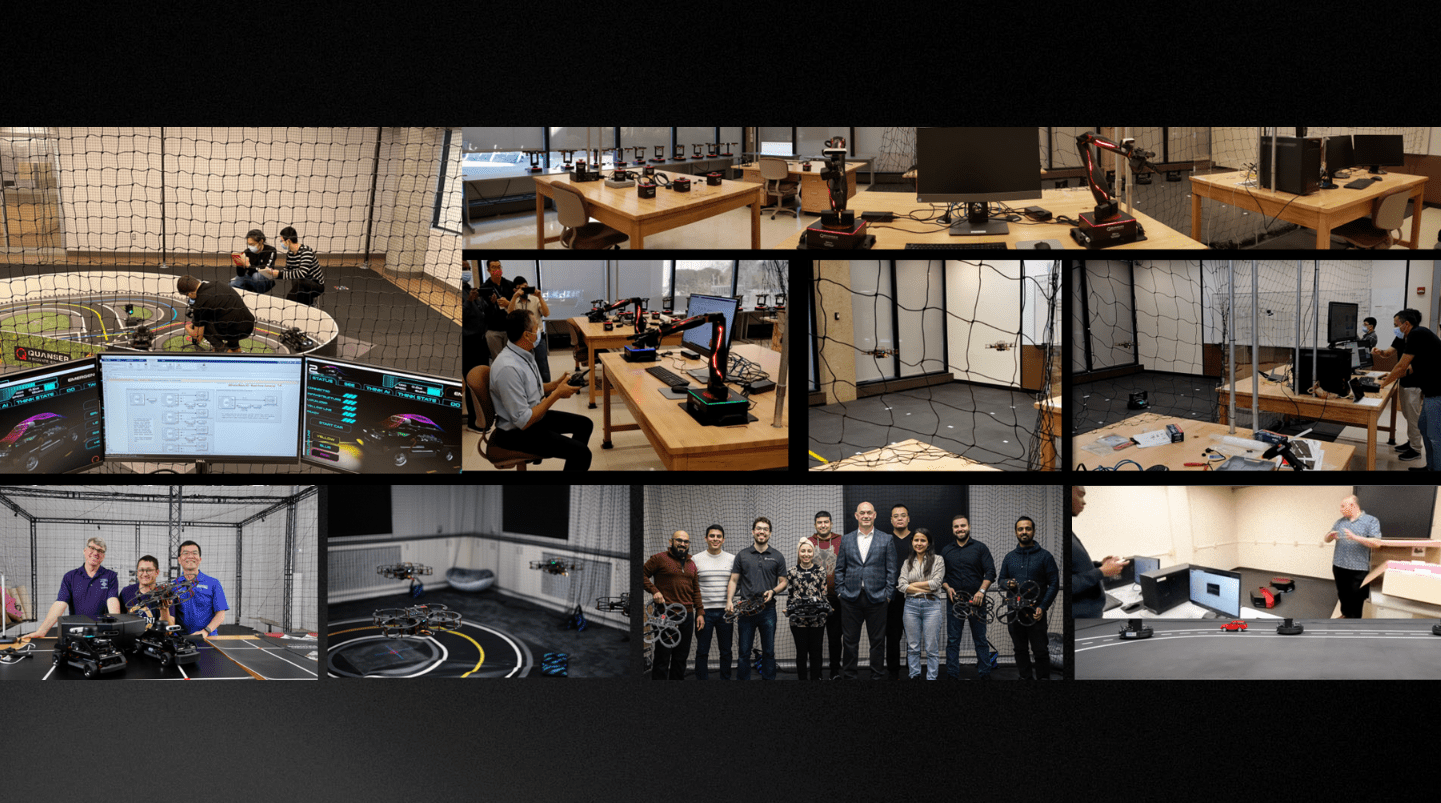
Each year, more than 250 research teams publish work using Quanser platforms. They work on standardized, research-ready hardware platforms, with results that other labs can compare against, learn from, and build on.
Quanser users are not just buying a research tool. They are joining a global community working on shared ground, publishing new ideas, comparing results, and helping the next group move faster with more confidence in what they are building on.
We are also developing tools that make this network easier to join and easier to use. If you are working under a deadline, preparing a grant proposal, or choosing a platform, this article will show how to move from scattered information to a clearer decision in hours, not weeks.
Has this platform been used by others?
Let’s say you found the Self-Driving Car Lab through a search, a paper, or a colleague’s recommendation. You open the product page, and before going deep into specs, you want to answer one question: are serious researchers already using this platform?
Next to the Self-Driving Car Lab, you see a Bioz Stars rating of 94 out of 100, with 55 citations.
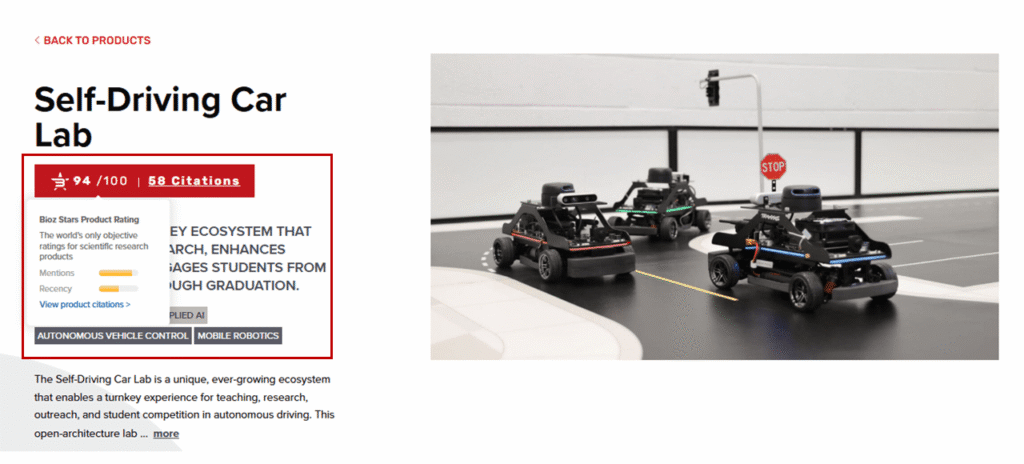
Bioz ratings are calculated from published scientific literature. They look at signals such as how often a product is cited in peer-reviewed journals, how recent those citations are, the impact factors of those journals, and other quantitative factors. Manufacturers cannot influence the rating.
So in a few seconds, you get a first signal: this platform has been used in highly rated published research and has a strong citation record.
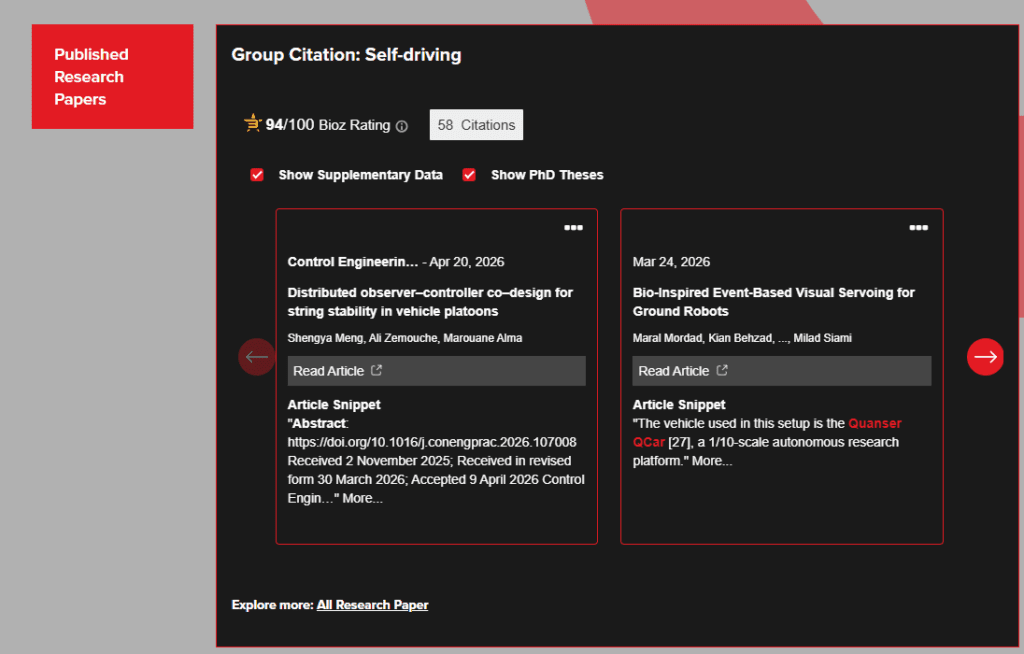
Then you click the citation count, which brings you to the actual papers, journals, and short summaries behind the number. In a few minutes, you can see who has used the platform, where it was published, and whether the work is worth exploring further.
Has it been used in my field, and are there any other platforms for my research?
Finding out that other researchers use the platform is a good start, but that is too broad for a signal. Let’s narrow it down. So you move from the product page to the Research Papers section, where, instead of searching by product, you search by application, where you can pick Applied AI, Autonomous Systems or others.
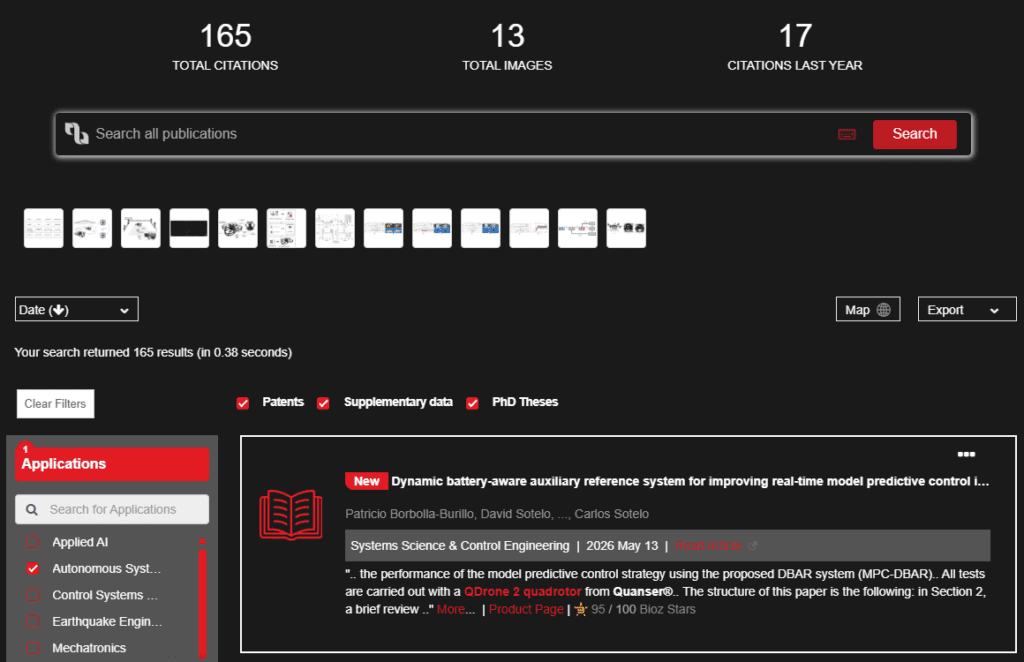
The library narrows to the papers most likely to match your work. Filter further by journal, author, or date. Every result carries a rating and a short summary.
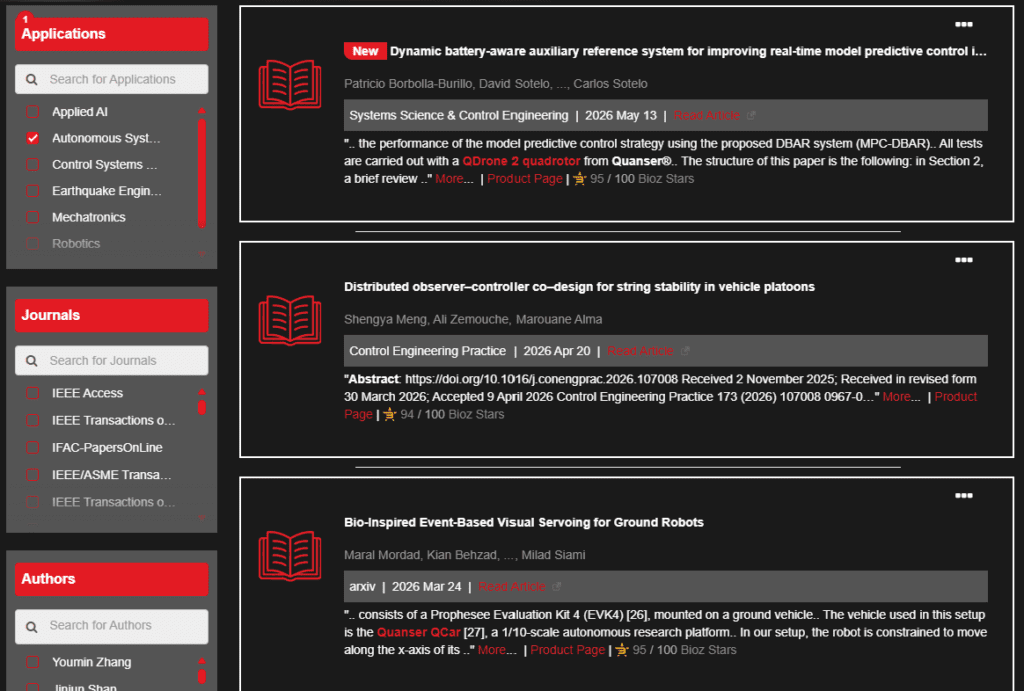
You scan a few papers. They are close to what you want to do. One of them is almost exactly what you want to do. Then the next practical question appears.
How quickly can I start building?
Finding a relevant paper is useful. But for a researcher under pressure, relevance is not enough.
The next question is: can I build from this quickly, or do I still have to start from zero?
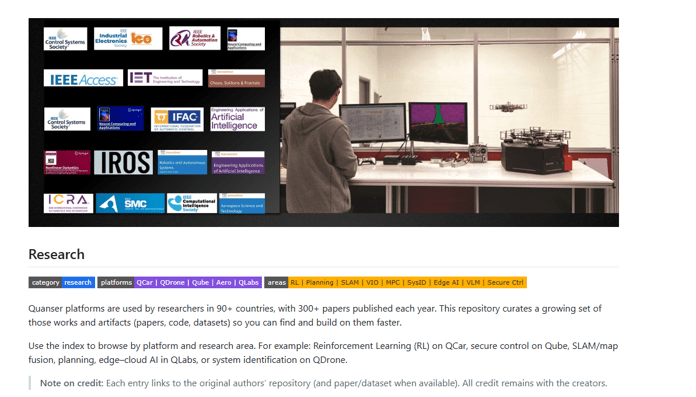
Beyond the publication library, we maintain a curated Research repository. It gathers papers, code and datasets from researchers using Quanser platforms, with full credit to the original authors and links to their codebase. The goal is simple: enable researchers to move from reading the work to expanding it.
The index lets you browse by institution, lab, platform, domain, and approach. You can quickly find projects close to your own work, see what platform was used, and jump directly to the original repository.
|
|
|
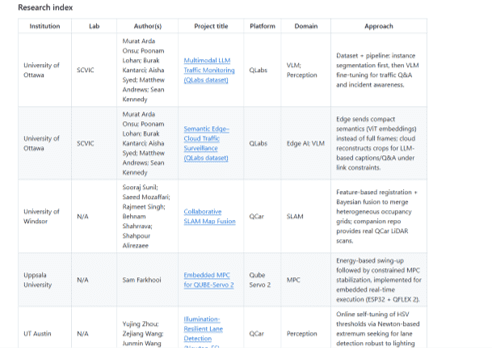
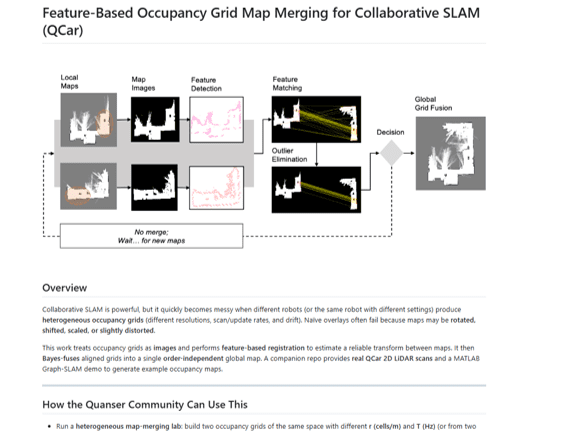
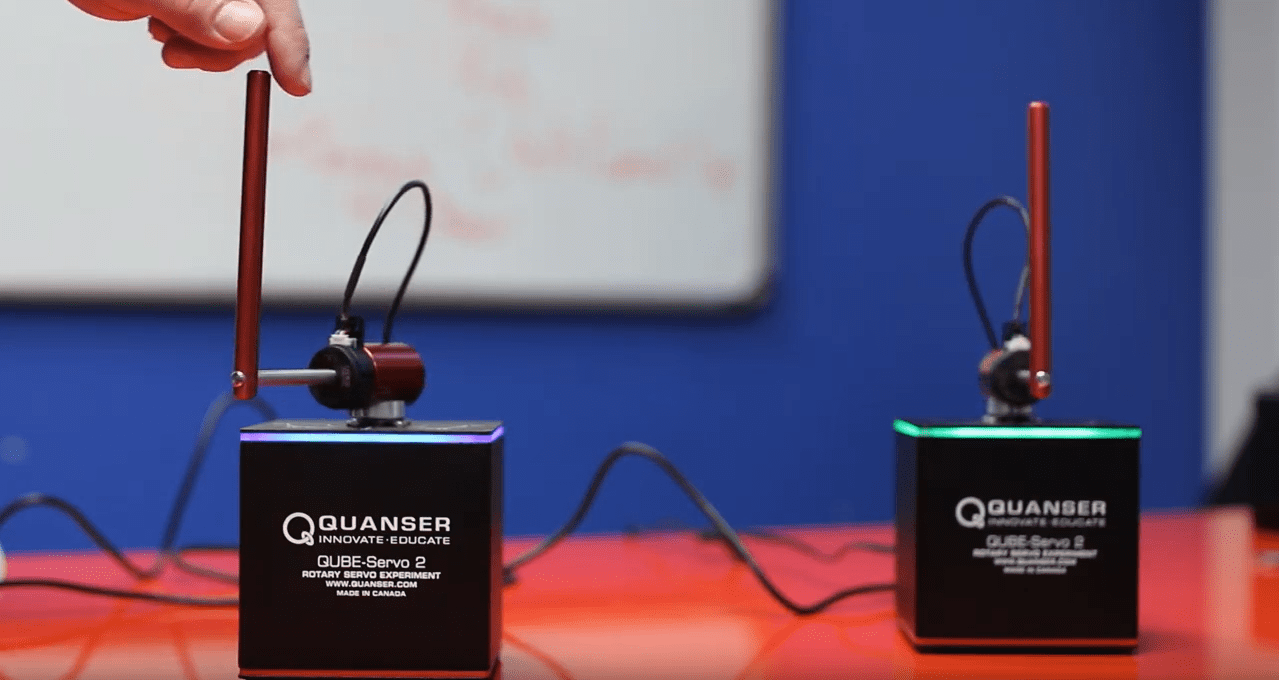
A team at the University of Windsor worked on Collaborative SLAM Map Fusion using QCar. A researcher at Uppsala built an embedded MPC pipeline using Qube Servo 2. Each entry becomes another starting point for the next researcher. For selected projects, we write a clear README that explains the work in simple language, shows how the Quanser community can use it, and points to the original implementation. You can clone, run, and extend. This is where the network becomes an accelerator for your research.
By now, you have moved from “is this credible?” to “is this relevant?” to “can I run it?” Three questions answered in maybe twenty minutes of browsing. There is one question left, and it is probably the biggest one.
Is the research community around it growing?
This is the question researchers may not ask out loud, but they feel it: am I building in a direction that is gaining momentum, or am I moving into a space that may not matter? The cost of missing the right opportunity is high.
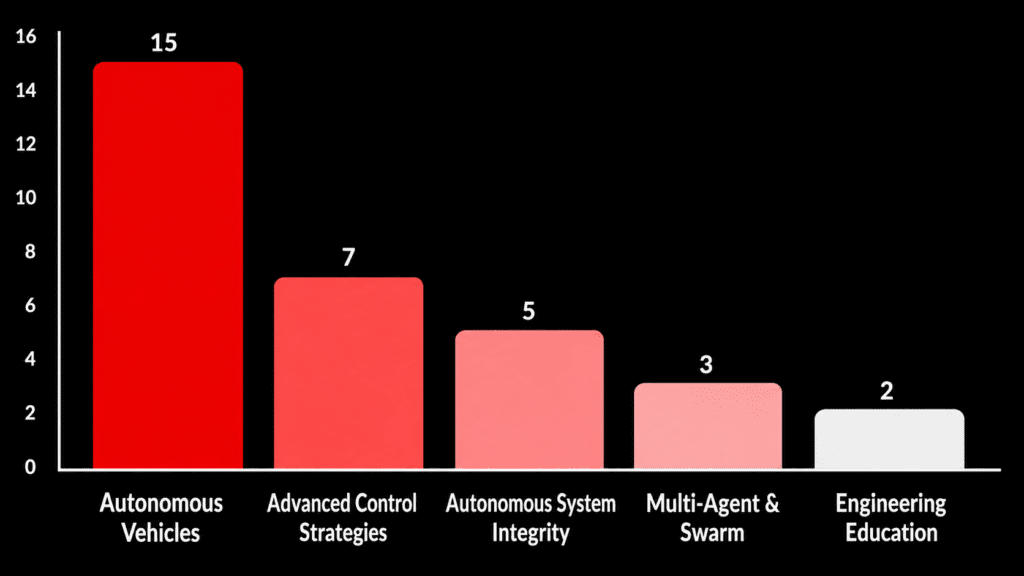
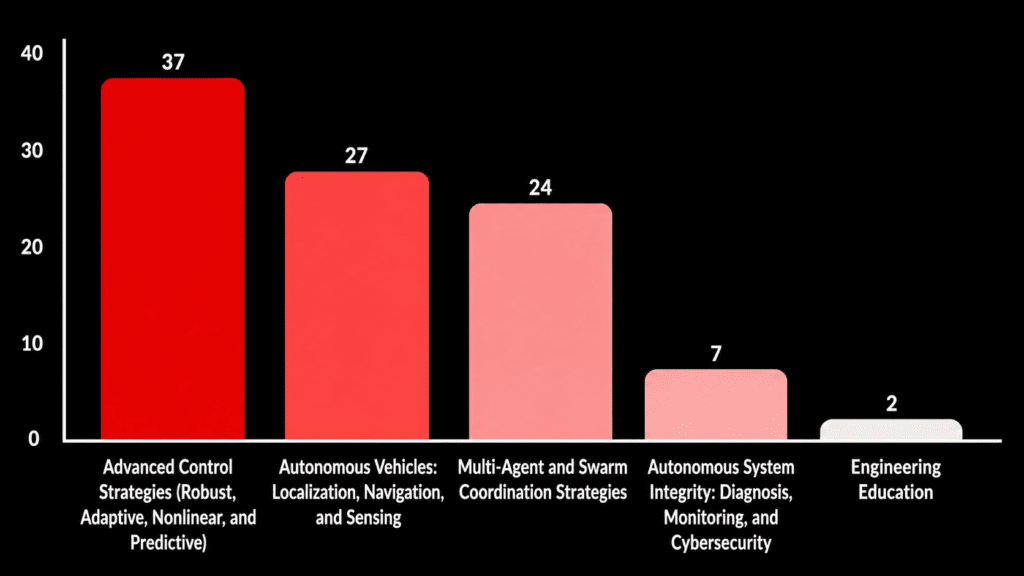
When needed, we can also provide deeper research trend insights by application, product, and year. For example, publication distribution by category can highlight where research attention is growing. Localization and mapping is increasingly prominent in self-driving research, while advanced control strategies remain especially popular in drone research. Cybersecurity is also becoming more visible across both self-driving and drone-related work.
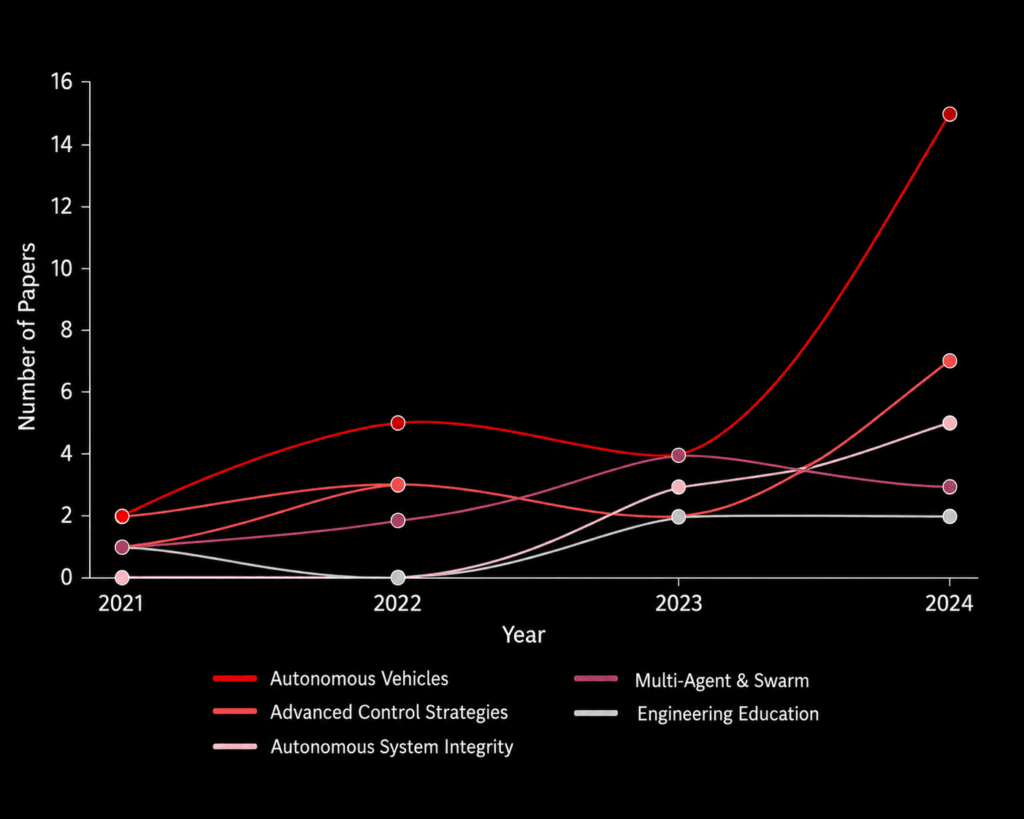
The analysis can go one level deeper. For example, in the self-driving car category, the trend is changing. Since Quanser solutions are highly instrumented and powered by strong NVIDIA GPUs, autonomous systems topics such as localization, mapping, and sensing have grown significantly. Cybersecurity is also gradually increasing.
You now have the full picture: credibility, relevance, executability, trajectory.
Join the Validation Network
When you choose a Quanser platform, you are not just buying equipment. You are joining a community of researchers in over 90 countries publishing almost 300 papers a year on standardized hardware.
Their results become easier to compare with yours. Their work can become a starting point for your next project. Your work can help the next researcher move faster.
That is the value of the Research Validation Network: a shared foundation where researchers can build, compare, repeat, and extend each other’s work. For a deeper analysis by application, product, or research area, you can contact me at Morteza.Mohammadi@Quanser.com.