
It’s 11:47 p.m. You finally have a quiet hour to yourself and you open the grant call again.
You scroll… highlight… reread the same paragraph three times – eligibility, scope, broader impacts, allowable costs, cost sharing, letters, partners, deadlines. Your cursor blinks in an empty document.
If you have felt that frustration, you are not alone.
To better understand what this moment feels like, we reviewed over 200 of the most viewed and discussed questions on Academia Stack Exchange. The examples below reflect the themes that came up repeatedly.
A large share of the most popular questions appear at the very start of the journey, before any writing begins. This is precisely where most applicants get stuck, riddled with uncertainty, hidden rules and a multitude of moving parts. Others ask whether this process could be outsourced or avoided, but even that exposes another barrier: cost. Most faculty want support but cannot afford external consultants or institutional services.
A Personal Frustration or a Broader Challenge?
This is not a problem that a limited number of applicants face. It is one of the biggest challenges in academic funding today.
For most engineering faculties, funding remains the hardest part of the lab development cycle. Across academia, competitive grants are still the primary source of support, with about 55% of academic R&D in the U.S. funded by federal agencies such as NSF, NIH, and DoD (NSF, 2023).
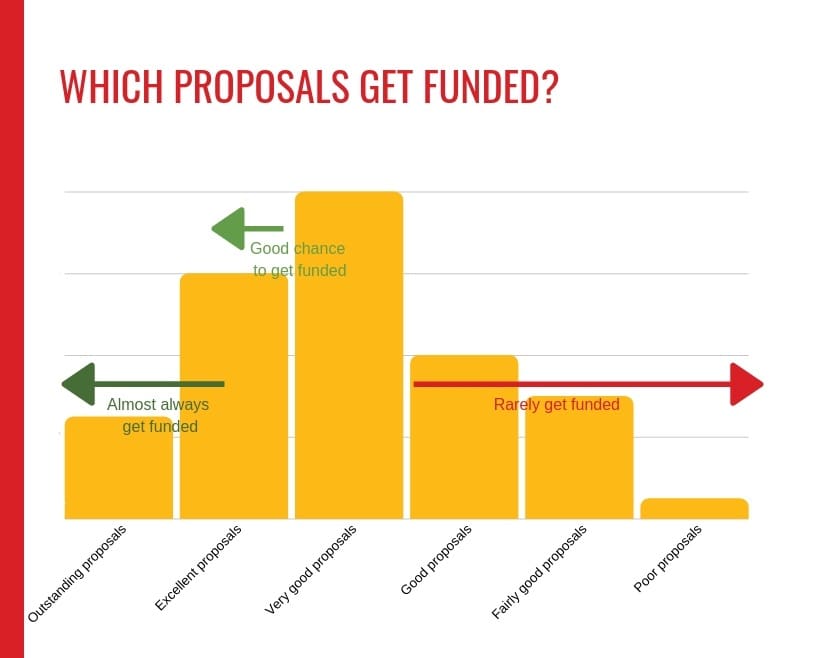
Securing a single grant is slow and costly. It can take 25-50 full working days to prepare a single proposal (arXiv, 2024), and given that success rates are that low, this workload often reaches 300 person-days per successful award (PMC, 2023). Meanwhile, 42-45% of a professor’s research time is consumed by grant-related administrative tasks—writing, compliance, and project management—rather than scientific work (arXiv, 2024).
Now consider zooming out to see the real scale of the problem. Faculty typically revisit and redesign their labs every five years to stay aligned with new trends, funding priorities, and academic goals. Each redesign depends on securing new grants, which, over a career, requires multiple rounds of grant applications.
Putting the Work Back into Academia, Not Paperwork
To understand the broader academic process around grants, we mapped a typical engineering research workflow across five steps: designing the lab, securing funding, building the lab, integrating the lab, and publishing outcomes.
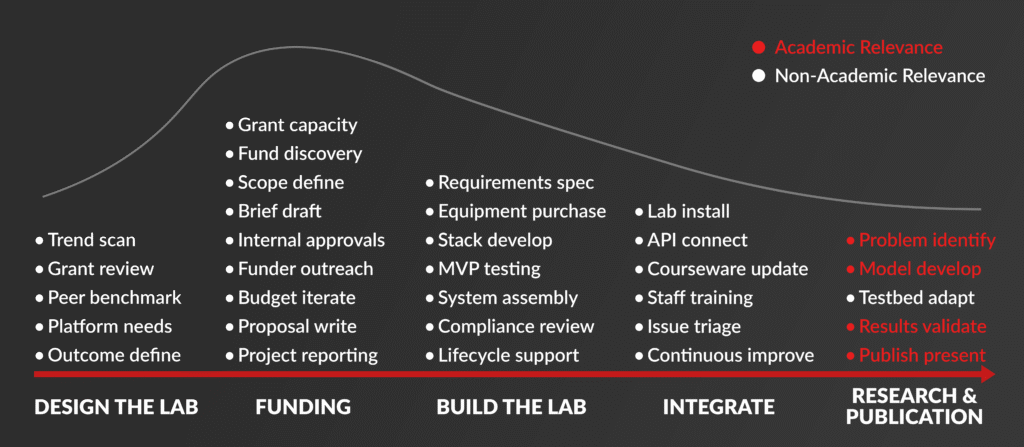
Our analysis suggests that nearly 88% of this workflow is not academically relevant. Professors should not be forced to act as market researchers, grant writers, engineers, and manufacturers on top of being researchers in their own field. These added responsibilities slow academic careers and pull faculty away from what matters most: teaching and research.
End-to-End Co-Development: Same Story, Much Bigger Scope
These insights lead to a clear conclusion: meaningful support cannot stop at proposal writing. It should follow researchers across the full academic process, from co-writing a grant proposal to co-authoring a research paper. That is why we created the End-to-End Co-Development model as a service for academia.
For 35 years, Quanser has put co-developing with universities at the center of its work. From the iconic Rotary Servo to advanced teleoperation systems, many of our platforms have grown out of long-term partnerships with academic faculty.
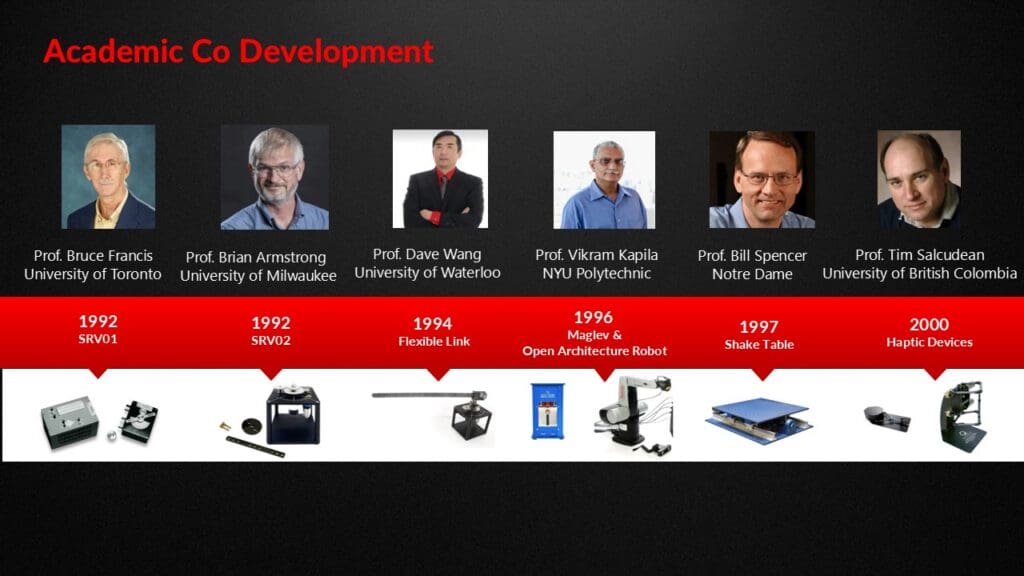
The End-to-End Co-Development model extends that partnership across the full academic workflow. We start by working with faculty to design labs aligned with long-term academic goals, with a focus on advanced complex systems and applied AI. From there, we support teams through the full cycle: co-writing grant proposals to secure funding, building turnkey labs, integrating them into curricula and research infrastructure, training staff, and co-authoring research outputs.
This model has already supported 33 institutions, contributing to more than 40 successful grants totaling $13 million and enabling hundreds of research publications. In one U.S. grant program last year, institutions using this coordinated approach achieved a 60% success rate, showing how end-to-end support can move ideas from concept to funded, future-ready solutions.
What Co-Development Looks Like in Practice
We understand how demanding the grant and proposal process can be because we live it. Founded by a professor, Quanser’s R&D has long been supported by external research funding, and our team includes both full-time and visiting PhD researchers who publish, mentor, and teach. That firsthand academic experience shapes how we support researchers throughout the grant process
As Amirpasha Javid, Director of Research Partnerships at Quanser, explains:
“We work side by side with principal investigators, reviewing and shaping every section of their proposals, not just to meet agency requirements, but to reflect their academic vision and maximize funding potential. Our support goes well beyond technical edits. We help researchers identify opportunities, refine ideas, build budgets, align scope, and form strategic partnerships. By reducing the non-academic workload that slows research, we enable teams to move faster from lab concepts to competitive, fundable proposals.”
Speed is only part of the value. When proposal development, lab design, and execution planning are built together, reviewers see a clearer path from equipment to outcomes, and funded projects begin with fewer delays and fewer surprises. That is what the End-to-End Co-Development model is designed to change.
What Changes When Quanser Is Your Co-Developer
That is the model. The real question is what changes when Quanser becomes a co-developer. Across institutions, we see three consistent outcomes: stronger proposals supported by versatile labs, more credible execution plans, and collaborations that continue into publishable research. The impact is best captured by our partners, in their own words.
Versatile Lab Platforms That Strengthen Proposals
Faculty often need lab solutions that serve multiple missions at once: teaching, research, outreach, and project-based learning, without locking them into a narrow use case. That versatility strengthens proposals because reviewers can clearly see the broader impact: a single lab investment can support multiple courses, multiple research directions, and multiple learner groups.
“Quanser’s versatile solutions, designed for teaching, research, outreach, and project-based learning, were crucial in applying for a grant. Their customizable nature allowed us to cover many topics and domains with a single solution, making the grant proposal more attractive.”
Dr. Amir Shahirinia, University of the District of Columbia.
Outcome snapshot:
| Acquisition of Advanced Robotics and Autonomous Vehicle Technology (ARAVT) for Research in Smart Grid Systems, Teaching, and K–12 Outreach | |
| University of the District of Columbia | |
| $391,796 |
Quanser Lab Solutions combine academic-ready hardware, software-agnostic platforms, high-fidelity digital twins, learning resources, and ongoing consultation to help departments build an industry-aligned hub that can evolve with future curriculum and research needs.
A DoD-funded Drone Lab reinforces the same pattern: one integrated setup supports AI-based cybersecurity research, hands-on training in autonomous systems, and STEM outreach, all within a single flexible, shared space.
Outcome Snapshot
| Enhancing Autonomous Vehicles Cybersecurity Through Innovative Software Systems | |
| St. Mary’s University | |
| $340,510 |
Closing the Implementation Gap (Ideas → Executable Plan)
Many proposals weaken, or fail, not because the ideas lack value, but because the execution plan is not concrete enough. Reviewers want to see how the work will be delivered: appropriate lab infrastructure, clear milestones, realistic scope, credible budgeting, and a clear path from equipment to outcomes. This is where Quanser’s co-development becomes most visible, translating academic vision into an execution plan that reads as deliverable.
“Academia excels at formulating ideas and identifying valuable outcomes. But when it comes to implementation, mapping research questions to the right lab infrastructure with clear milestones is where engineers and experts like those at Quanser help close the gap.”
Dr. Fadel Lashhab, Howard University.
Outcome Snapshot
| Enhancing Autonomous Vehicles Research and STEM Education Through Studio and Control Equipment Acquisition | |
| DoD HBCU/MI Research and Education Program | |
| $630,000 instrumentation award |
Partners also emphasize that this support feels like collaboration, not sales. Quanser strengthens proposals by helping teams align domains, platforms, and applications with a grant’s evaluation criteria, while keeping academic goals front and center.
“Quanser has been more than a supplier. They are a true collaborator. Their guidance and active involvement have strengthened our grant proposals and helped them stand out. This partnership not only brings the latest innovations into our research, but also creates valuable experiential learning opportunities for our students.”
Dr. Burak Kantarci, University of Ottawa.
“Quanser’s team played a vital role in developing the proposal by identifying relevant domains, products, and applications across academic levels. Their experts worked closely with us to create strong, compelling grant proposals, providing valuable data and insights to strengthen the case.”
Dr. Amir Shahirinia, University of the District of Columbia.
The Reliable Partner From Idea to Publication
Quanser stays involved beyond delivery. We help shape proposals, support lab build and integration, train teams, and remain engaged as labs are used in real coursework and research.
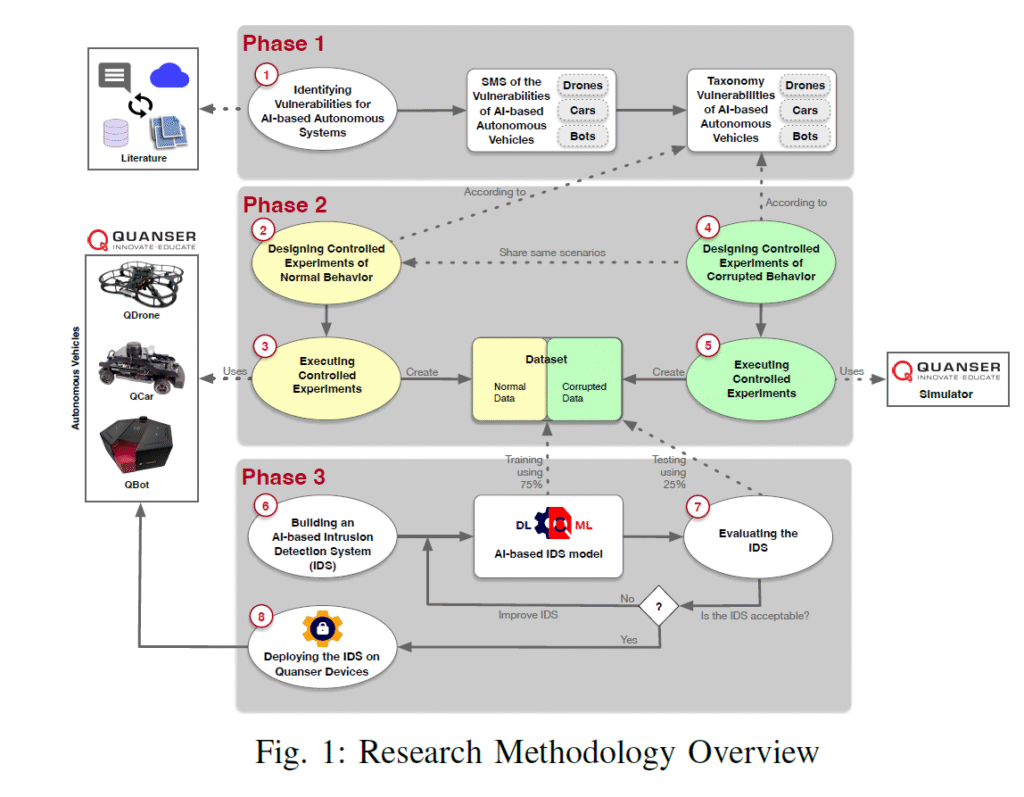
One example is the paper “Intrusion Detection Systems for Enhancing Security in Autonomous Vehicles co-authored with Dr. Damiano Torre (University of Washington Tacoma). As Amirpasha Javad notes, the publication grew out of a longer collaboration that began earlier, including the joint success of a DoD research equipment grant to establish a cybersecurity lab for autonomous systems.
A practical challenge in AI-driven autonomy is data: collecting enough high-quality, well-structured datasets to evaluate security methods under realistic conditions. In this work, the team presents a framework for generating multimodal datasets using Quanser’s QDrone, QCar, and QBot platforms. The setup captures both normal and disrupted behaviors across autonomous vehicles, with synchronized sensor, communication, and control data.
Conclusion
It’s 11:47 p.m. again. The grant call is open, the cursor blinks, and the question is the same: how do I get this process moving?
This is the moment the Quanser End-to-End Co-Development model was built for. We know how difficult it can be to secure funding and move from an idea to a working lab, and then to publishable outcomes. That is why we bring more than three decades of experience into a practical model that supports faculty across the full workflow, from co-writing a grant proposal to co-authoring research.
The goal is simple: reduce the non-academic burden that causes delays, so you can focus on what matters most: your research, your students, and your teaching.
If you would like to explore collaboration, please reach out to Amirpasha Javid, Director of Research Partnerships at Quanser at amirpasha.javid@quanser.com