

Manipulator Robotics
The current trend of physical AI adoption has renewed interest in manipulator robotics which were once thought of as strictly related to industrial solutions and niche applications. At Quanser we sat down to understand how this trend is changing and growing. The global market for manipulators is roughly 15B and growing at around 12% annually. For academics this poses a big question: How can I ensure my students have the technical foundation necessary to thrive in an ever-growing industry which is also rapidly changing as physical AI is opening new doors.
Practically, an institution can take the following approach: Purchase an industrial arm and have a lab technician/research assistant make the changes necessary for the courses and research needs of an institution. A very real outcome for educators is a custom solution where the research, learning, accessibility come at cost.
Quanser Manipulator Family
Looking at Quanser’s academic DNA and the breath of solutions we’ve created over the past 35 years, we took a deeper look at what it meant to develop a manipulator specifically for academia. Our goal was to ensure we met the following design philosophy:
- A solution ecosystem tailored to cover all aspects of modern engineering education and research.
- Open-architecture and highly instrumented, with robust performance and multiple control modes.
- Includes full curriculum support aligned with leading textbooks, project-based learning content, and a broad library of education and research examples.
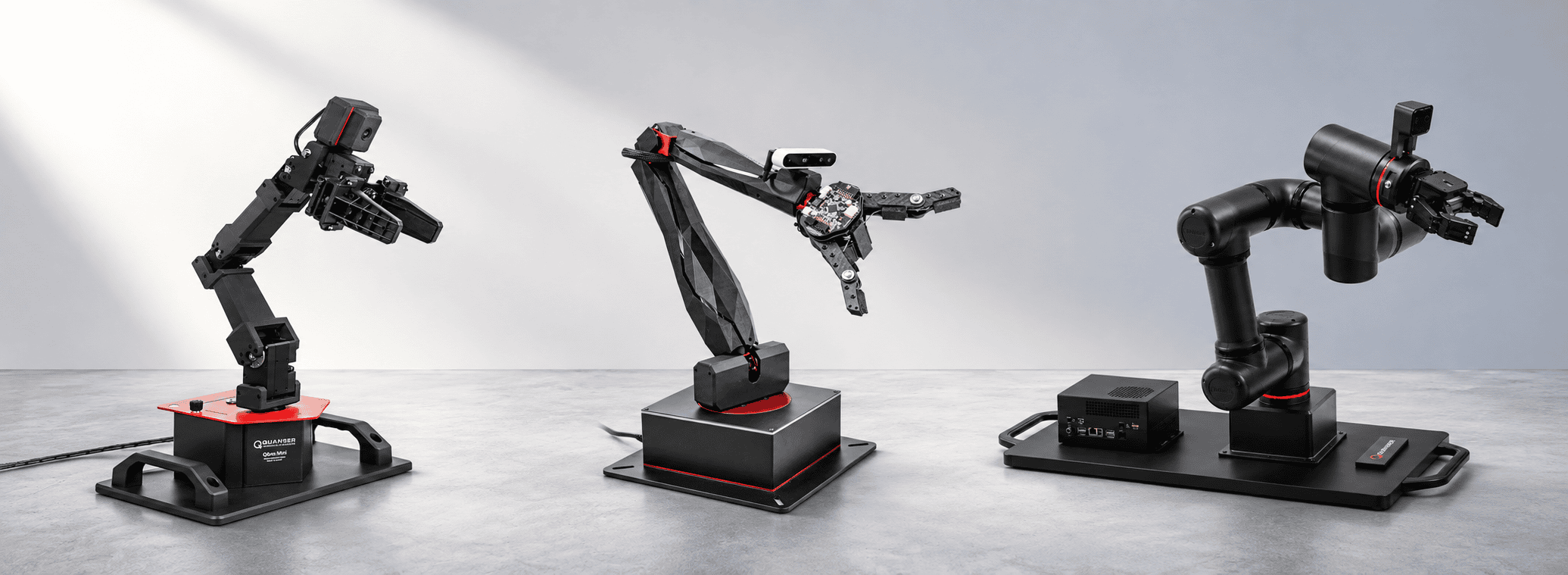
In 2020 we began to tackle these ideas with the Quanser QArm. Designed for teaching advanced undergrad courses, and even graduate level robotics classes. The Quanser QArm became our answer to the following question: What open architecture robotic arms are there for teaching manipulator robotics in an undergrad and graduate setting? Reviewing our design philosophy, we made sure to instrument our QArm in a way where modern manipulator engineering topics were brought to life via our unique approach to Simulink based curriculum.
Following this idea, in 2024 we released the QArm mini. A hands-on scalable course ready manipulator for universities looking to motivate students with robotics at an introductory level. QArm mini also gave Quanser a unique opportunity to demonstrate mobile manipulation by enabling educators to mount this arm onto a QBot Platform and bridge the gap between manipulators and mobile robotics. This design choice was intentional since it allows universities to explore manipulator robotics in a different operating environment.
This brings us to 2026 with the release of QArm Research. Our latest member of Quanser’s manipulator family. QArm Research focuses on the intersection of traditional robotics, applied AI workflows and physical AI applications. What makes the QArm Research the ideal platform is the ideal intersection of comprehensive sensor suite for each joint, NVIDIA edge compute with the Jetson Orin AGX and a 3 kg payload. QArm Research added another pilar to our design philosophy which is:
- Solutions that support versatile development support for Python, Simulink, ROS 2, C++, NVIDIA Isaac Sim, and leading AI libraries.
Now that we understand what got us here, let’s analyze which solution would work best for you.
Which Manipulator Works Best for Me?
To try and unpack this question, let’s take a deeper look at what makes each manipulator unique. Both QArm Mini and QArm empower teaching professors with the courseware. Quanser’s academic content always comes with the elements shown in Figure 1.
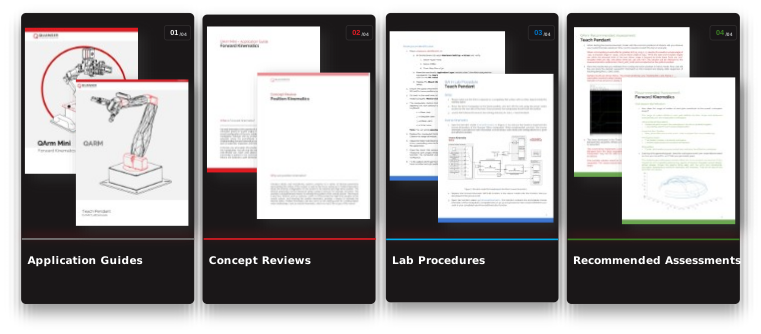
Figure 1: Quanser courseware elements
However, there is a distinction between the courseware provided by the QArm Mini compared to the QArm.
 |
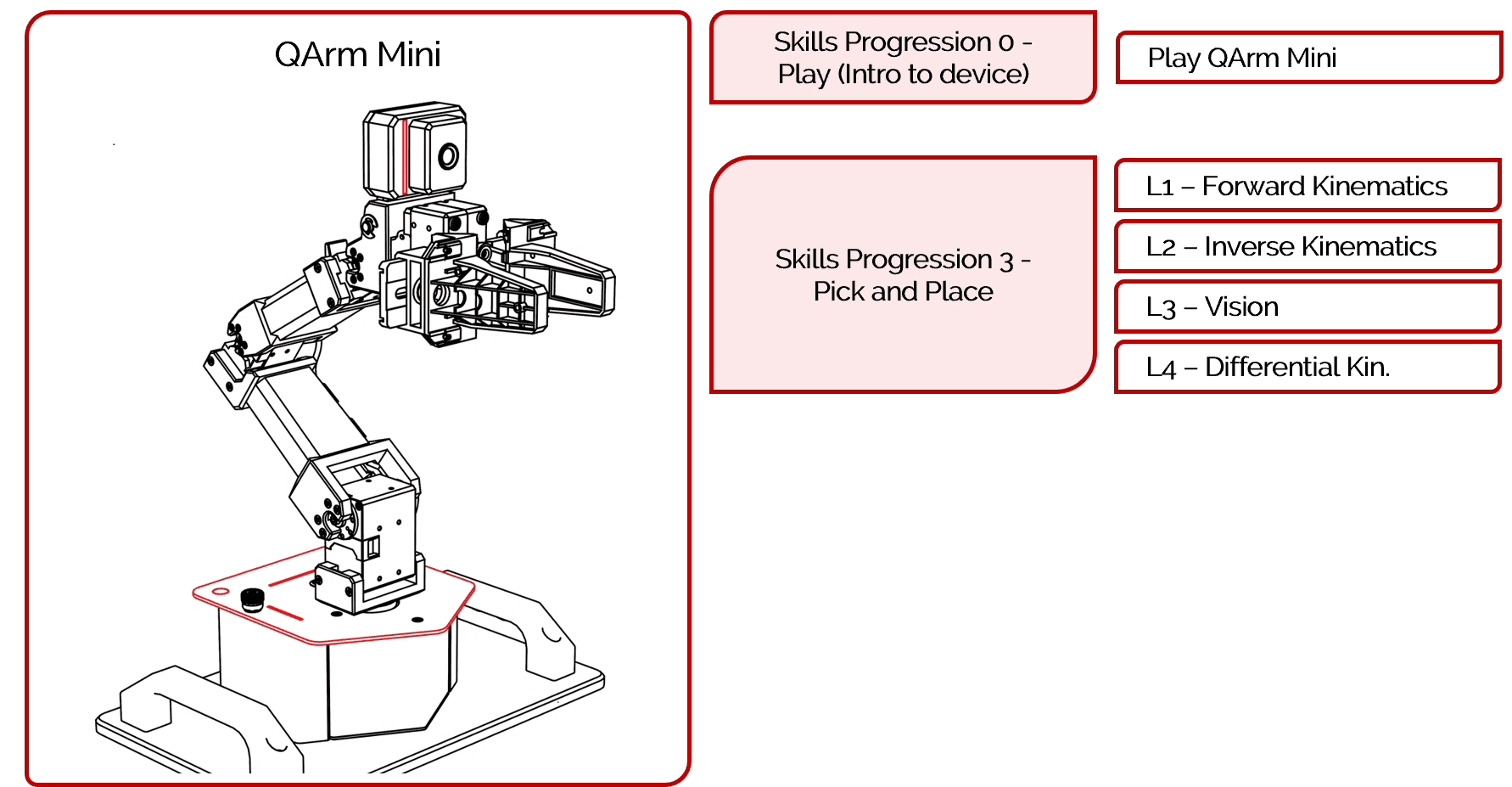 |
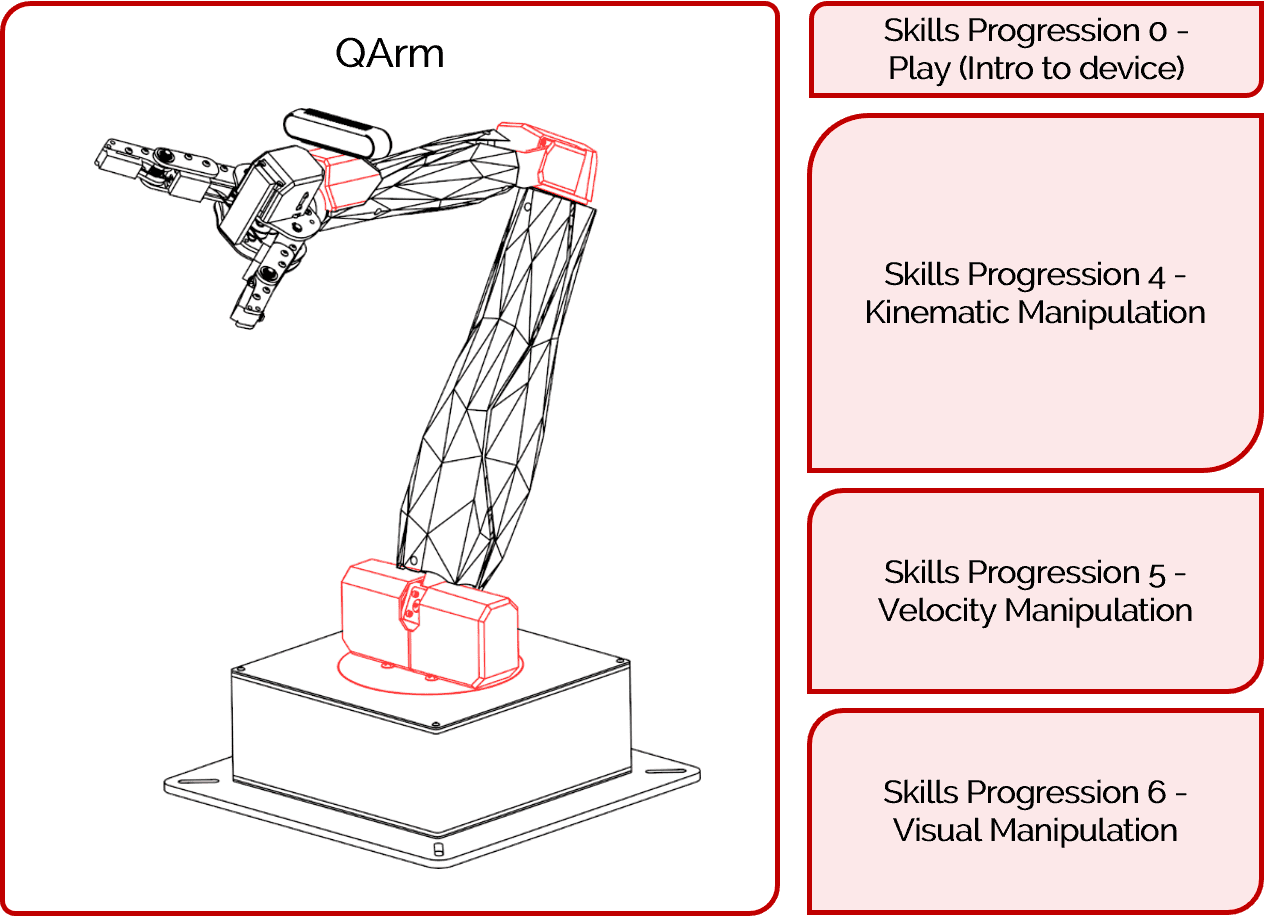
| QArm Teaching skills progressions | QArm Mini skills progressions |
For QArm we have a total of 11 labs spread across 4 skills progressions. The labs are currently designed for both the digital and physical devices. QArm curriculum covers fundamental control, forward/inverse kinematics, trajectory generation, learn and teach applications, and vision-based labs for a wide range of applications focused on manipulator robotics. Designed in Simulink, these applications focus primarily on the algorithms and theory implementation of robotic manipulation and were inspired by the book “Robot Modeling and Control” by M. Spong & M. Vidyasagar.
Video 1: QArm with Digital Twin
QArm Mini takes a different approach and focuses on flexibility and scalability, primarily if seen through the lens of the Intro To Robotics Teaching Lab. Courseware content was designed with a multilanguage approach (Simulink and Python). Students can now get an introductory look at manipulators from an industry perspective using Simulink or take an open-source approach and use python. Educators who want to explore variable configurations can utilize the mounting points on the QBot Platform and expand their education goals by focusing on mobile manipulation applications.
Video 2: QArm Mini on QBot Platform
QArm Research takes on a different approach and looks at the world of AI from the lens of Isaac Sim, Isaac Lab, ROS, Physical AI and haptic Teleoperation. This decision was deliberate due to the growing demand for NVIDIA tools to empower physical AI research. This doesn’t mean we have dropped Simulink support. Released with our examples we also have Simulink models for task space and joint space control if that’s how you would like to get started with our solution. A rich development environment is what makes QArm Research the key element in within Quanser’s Physical AI Lab.
If your area of study focuses on real-time haptic feedback for classical control or for imitation learning-based applications the QArm Research has the support for end effector force torque sensing.
Video 3: Haptic Robot And QArm Imitation learning
To empower researchers in AI workflows within the context of complex systems, we also looked at how an institution might go about combining two common frameworks: Physical AI and Applied AI. We trained a policy for reaching a specified location and retrained a YOLO NN to detect an object and provide to us task space coordinates. This is the type of troubleshooting, documentation and applications that Quanser provides to meet your research right where it is at.
Video 4: QArm RL pick and place
Choosing the right manipulator
So how do you decide which manipulator is right for you? I would start by looking at our Academic Resources in GitHub. If you want to take a deeper dive at our teaching side, the 6_teaching directory on the repository has all the content you need to get started. This view is broken down into topics and supported hardware solutions. If you’re looking at what our research examples cover then 5_research directory is where I’d go to instead. This view is broken down by products and here is where you can start to get inspiration based on the released examples provided by Quanser.
Sometimes it’s easier to dream when you have a launchpad of what’s possible. If this is you, then I’d invite you to look at the 8_user_content folder. This showcases community generated content and highlights the multiple pathways an academic can follow with our solutions.
A visual breakdown of some considerations I’d look at if I was choosing the right manipulator for my institution:
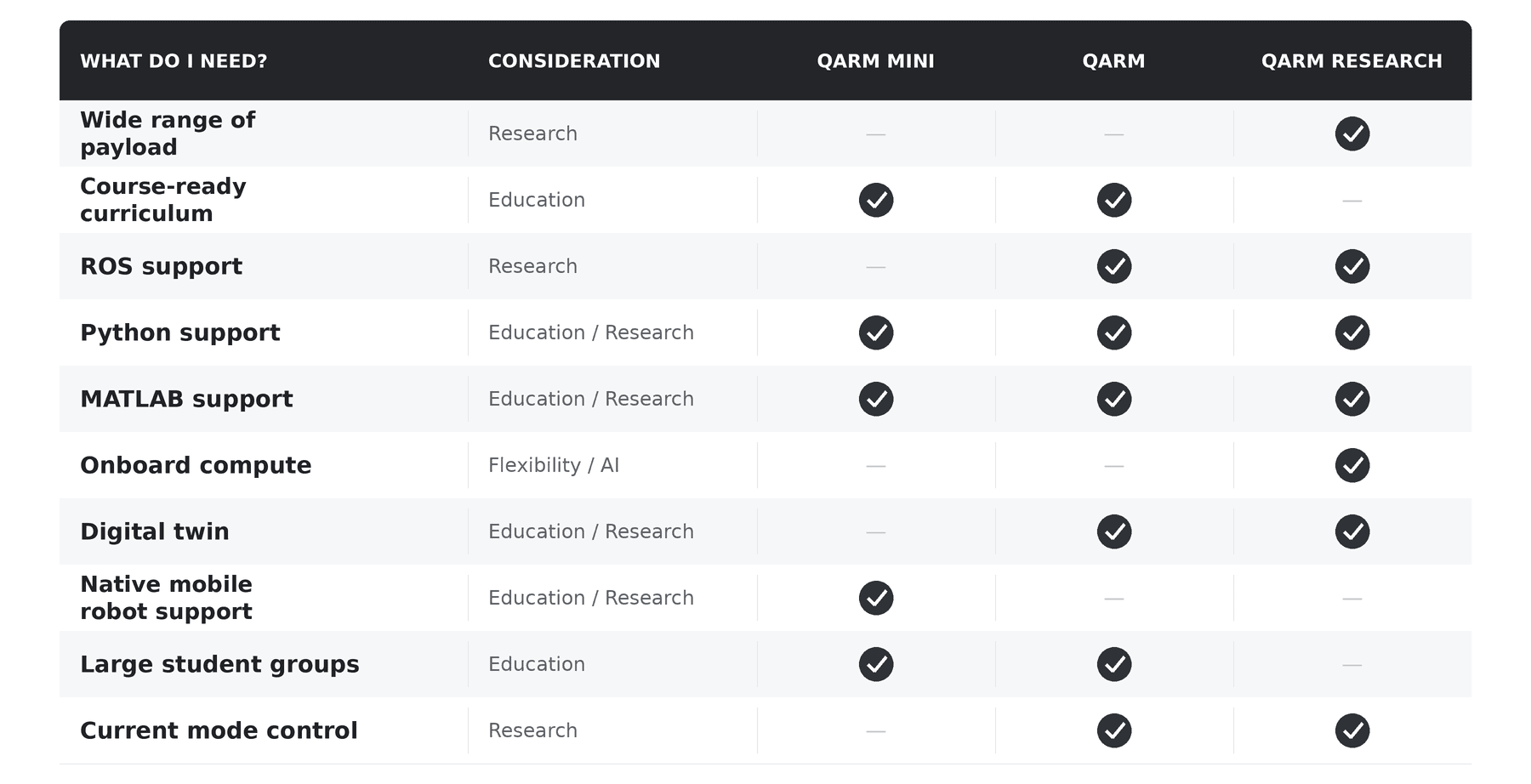 This is a visual guideline but not a definitive one. We’d love to hear from you directly and understand what your needs are so we can work with you to get you the solution that has the highest impact.
Feel free to contact us and learn more!